
|
You entered: image
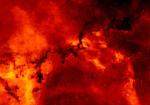 Hydrogen and Dust in the Rosette Nebula
22.12.2005
At the edge of a large molecular cloud in Monoceros, some 3,000 light years away, dark filaments of dust are silhouetted by luminous hydrogen gas. The close up view of the Rosette Nebula...
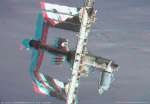 Stereo Space Station
22.02.2008
Get out your red-blue glasses and float next to the International Space Station (ISS), planet Earth's largest artificial moon. This fun stereo view was constructed from parts of two separate images (S122-E-009880, S122-E-009893) and an additional background recorded as the shuttle orbiter Atlantis undocked from the ISS on February 18.
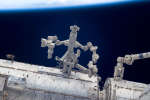 Dextre Robot at Work on the Space Station
11.06.2008
What's the world's most complex space robot doing up there? Last week, Dextre was imaged moving atop the Destiny Laboratory Module of the International Space Station (ISS), completing tasks prior to the deployment of Japan's Kibo pressurized science laboratory.
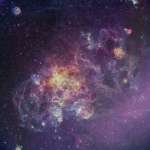 The Tarantula Zone
16.09.2009
The Tarantula Nebula is more than 1,000 light-years in diameter -- a giant star forming region within our neighboring galaxy the Large Magellanic Cloud (LMC). That cosmic arachnid lies left of center in this in this colorful telescopic image taken through narrow-band filters. It covers a part of the LMC over 2,000 light-years across.
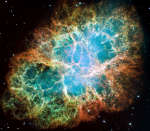 M1: The Crab Nebula from Hubble
25.12.2011
This is the mess that is left when a star explodes. The Crab Nebula, the result of a supernova seen in 1054 AD, is filled with mysterious filaments. The filaments are not only tremendously complex, but appear to have higher speed than expected from a free explosion.
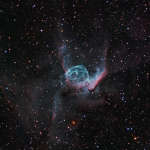 Thor s Helmet
7.03.2013
This helmet-shaped cosmic cloud with wing-like appendages is popularly called Thor's Helmet. Heroically sized even for a Norse god, Thor's Helmet is about 30 light-years across. In fact, the helmet is actually...
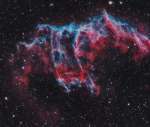 A Spectre in the Eastern Veil
30.10.2013
Frightening forms and scary faces are a mark of the Halloween season. They also haunt this cosmic close-up of the eastern Veil Nebula. The Veil Nebula itself is a large supernova remnant, the expanding debris cloud from the death explosion of a massive star.
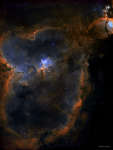 Bright from the Heart Nebula
26.10.2015
What's that inside the Heart Nebula? First, the large emission nebula dubbed IC 1805 looks, in whole, like a human heart. The nebula glows brightly in red light emitted by its most prominent element: hydrogen.
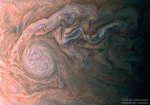 A White Oval Cloud on Jupiter from Juno
27.02.2017
This storm cloud on Jupiter is almost as large as the Earth. Known as a white oval, the swirling cloud is a high pressure system equivalent to an Earthly anticyclone. The cloud is one of a "string of pearls" ovals south of Jupiter's famous Great Red Spot.
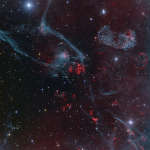 Puppis A Supernova Remnant
28.09.2017
Driven by the explosion of a massive star, supernova remnant Puppis A is blasting into the surrounding interstellar medium about 7,000 light-years away. At that distance, this colorful telescopic field based on broadband and narrowband optical image data is about 60 light-years across.
|
January February March April May June July August September |
|||||||||||||||||||||||||||||||||||||||||||||||||