
|
You entered: image
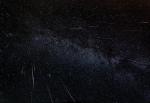 Raining Perseids
6.08.2005
Comet dust rained down on planet Earth last August, streaking through dark skies in the annual Perseid meteor shower. So, while enjoying the anticipated space weather, astronomer Fred Bruenjes recorded a series of many 30 second long exposures spanning about six hours on the night of August 11/12 using a wide angle lens.
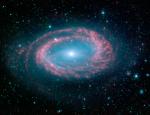 One Armed Spiral Galaxy NGC 4725
1.09.2005
While most spiral galaxies, including our own Milky Way, have two or more spiral arms, peculiar galaxy NGC 4725 has only one. In this false-color Spitzer Space Telescope infrared image, the galaxy's solo spira mirabilis is seen in red, highlighting the emission from dust clouds warmed by newborn stars.
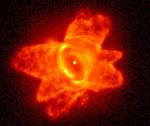 PKS285 02: A Young Planetary Nebula
22.06.1999
How do planetary nebulae acquire their exquisite geometrical shapes? To investigate this, astronomers used the Hubble Space Telescope to image several young planetary nebulae. These nebulae are the outer envelopes of stars like our Sun that have recently been cast away to space, leaving behind a core fading to become a white dwarf.
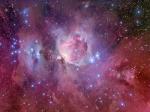 M42: Wisps of the Orion Nebula
20.11.2006
The Great Nebula in Orion, an immense, nearby starbirth region, is probably the most famous of all astronomical nebulas. Here, glowing gas surrounds hot young stars at the edge of an immense interstellar molecular cloud only 1500 light-years away. In the above deep image, faint wisps and sheets of dust and gas are particularly evident.
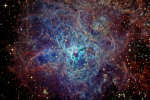 The Cosmic Web of the Tarantula Nebula
11.11.2008
First cataloged as a star, 30 Doradus is actually an immense star forming region in nearby galaxy The Large Magellanic Cloud. The region's spidery appearance is responsible for its popular name, the Tarantula nebula, except that this tarantula is about 1,000 light-years across, and 180,000 light-years away in the southern constellation Dorado.
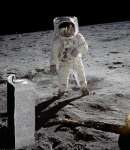 Evidence Mounts for Water on the Moon
1.04.2010
In 2009, space missions revealed tantalizing signs of water on or near the lunar surface, once thought of as a dry and desolate environment. But researchers are now offering this archival picture as further evidence that humans might one day be able to use the Moon's newly discovered resource to directly quench their thirst.
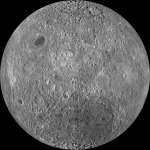 Lunar Farside
9.04.2011
Tidally locked in synchronous rotation, the Moon always presents its familiar nearside to denizens of planet Earth. From lunar orbit, the Moon's farside can become familiar, though. In fact this sharp picture, a mosaic from the Lunar Reconnaissance Orbiter's wide angle camera, is centered on the lunar farside.
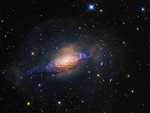 NGC 3521: Galaxy in a Bubble
15.09.2011
Gorgeous spiral galaxy NGC 3521 is a mere 35 million light-years away, toward the constellation Leo. Relatively bright in planet Earth's sky, NGC 3521 is easily visible in small telescopes but often overlooked by amateur imagers in favor of other Leo spiral galaxies, like M66 and M65.
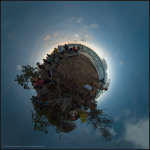 Umbra World
14.12.2012
On the morning of November 14, sky gazers from around the world gathered on this little planet to stand in the dark umbral shadow of the Moon. Of course, the Moon cast the shadow...
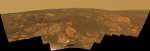 Matijevic Hill Panorama
25.01.2013
On January 25 (UT) 2004, the Opportunity rover fell to Mars, making today the 9th anniversary of its landing. After more than 3,200 sols (Mars solar days) the golf cart-sized robot from Earth is still actively exploring the Red Planet, though its original mission plan was for three months.
|
January February March April May June July August September |
|||||||||||||||||||||||||||||||||||||||||||||||||