
|
You entered: image
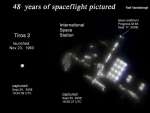 48 Years of Space Flight
16.10.2008
This year, NASA celebrated its 50th anniversary. Inspired to make his own contribution, astronomer Ralf Vandebergh set out to record images of some historic spacecraft in Earth orbit -- captured with his own modest equipment and a hand-guided, 10-inch, Newtonian reflecting telescope. One result is this intriguing composite effectively spanning 48 years of space flight!
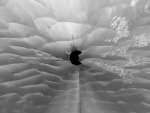 Martian Dunes and the Shadow of Opportunity
24.03.2009
Human made robots continue to roll across the surface of Mars. Both Opportunity and its sister rover Spirit are in their sixth year on Mars, exploring the red planet for years longer than original expectations.
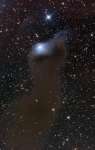 VdB 152: Reflection Nebula in Cepheus
31.10.2009
Described as a "dusty curtain" or "ghostly apparition", mysterious reflection nebula VdB 152 really is very faint. Far from your neighborhood on this Halloween Night, the cosmic phantom is nearly 1,400 light-years away. Also cataloged as Ced 201, it lies along the northern Milky Way in the royal constellation Cepheus.
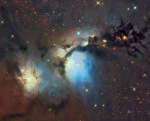 M78 and Reflecting Dust Clouds in Orion
2.03.2010
An eerie blue glow and ominous columns of dark dust highlight M78 and other bright reflection nebula in the constellation of Orion. The dark filamentary dust not only absorbs light, but also reflects the light of several bright blue stars that formed recently in the nebula.
 Star Factory Messier 17
30.06.2011
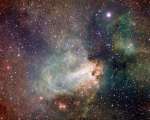
Sculpted by stellar winds and radiation, the star factory known as Messier 17 lies some 5,500 light-years away in the nebula-rich constellation Sagittarius. At that distance, this degree wide field of view spans almost 100 light-years, courtesy of ESO's new VLT Survey Telescope and OmegaCAM.
 At the West Wall of Aristarchus Crater
17.02.2012
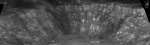
Aristarchus Plateau is anchored in the vast lava flows of the Moon's Oceanus Procellarum. At the plateau's southeastern edge lies the spectacular Aristarchus Crater, an impact crater 40 kilometers wide and 3 kilometers deep.
 M13: The Great Globular Cluster in Hercules
14.06.2012
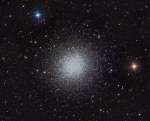
In 1716, English astronomer Edmond Halley noted, "This is but a little Patch, but it shews itself to the naked Eye, when the Sky is serene and the Moon absent." Of course, M13 is now modestly recognized as the Great Globular Cluster in Hercules, one of the brightest globular star clusters in the northern sky.
 M72: A Globular Cluster of Stars
19.08.2012
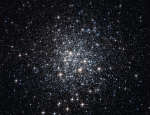
Globular clusters once ruled the Milky Way. Back in the old days, back when our Galaxy first formed, perhaps thousands of globular clusters roamed our Galaxy. Today, there are less than 200 left. Many globular clusters were destroyed over the eons by repeated fateful encounters with each other or the Galactic center.
 No X rays from SN 2014J
16.08.2014
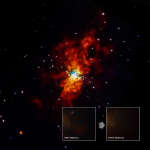
Last January, telescopes in observatories around planet Earth were eagerly used to watch the rise of SN 2014J, a bright supernova in nearby galaxy M82. Still, the most important observations may have been from orbit where the Chandra X-ray Observatory saw nothing.
 Suiting Up for the Moon
1.04.2015
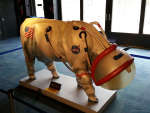
How will cows survive on the Moon? One of the most vexing questions asked about space, scientists have spent decades debating this key issue. Finally, after extensive computer modeling and over a dozen midnight milkings, engineers have designed, built, and now tested the new Lunar Grazing Module (LGM), a multi-purpose celestial bovine containment system.
|
January February March April May June July August September |
|||||||||||||||||||||||||||||||||||||||||||||||||