
|
You entered: image
 The Horsehead Nebula
10.12.2025
Sculpted by stellar winds and radiation, this dusty interstellar molecular cloud has by chance has assumed an immediately recognizable shape. Fittingly known as The Horsehead Nebula, it lies some 1,500 light-years distant, embedded in the vast Orion cloud complex.
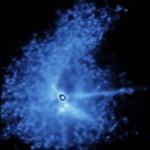 The T Tauri Star Forming System
4.06.2001
What did the Sun look like before there were planets? A prototype laboratory for the formation of low mass stars like our Sun is the T Tauri system, one of the brighter star systems toward the constellation of Taurus. In young systems, gravity causes a gas cloud to condense.
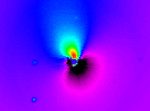 A Dust Jet From Hale-Bopp
29.07.1996
Approaching the inner Solar System, comet Hale-Bopp's icy nucleus is heated by sunlight, accelerating its production of dust and gas. Shrouded in the resulting cloud, known as the coma, the cometary nucleus remains hidden from direct view.
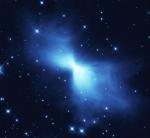 Cold Wind from the Boomerang Nebula
20.02.2003
A cold wind blows from the central star of the Boomerang Nebula. Seen here in a detailed false-color image recorded in 1998 by the Hubble Space Telescope, the nebula lies about 5,000 light-years away towards the grand southern constellation of Centaurus.
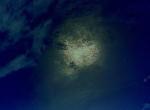 Spiral Eddies On Planet Earth
20.10.1997
Can you identify this stellar nebula? How many light-years from Earth did you say? Looking like a twisting cloud of gas and dust between the stars this wispy nebulosity is actually close by - a spiral eddy formed near the North Atlantic Gulf Stream off the East coast of the US.
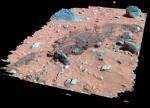 Martian Surface in Perspective
16.01.2004
Spirit moved across Mars yesterday as the rover successfully maneuvered down off its lander, driving its six wheels onto the floor of Gusev crater. As planned, the robotic geologist will now begin a close-up examination of the rocks and soil around the landing site for clues to the processes that formed them.
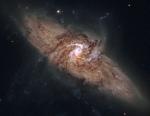 NGC 3314: When Galaxies Overlap
7.05.2005
NGC 3314 consists of two large spiral galaxies which just happen to almost exactly line-up. The foreground spiral is viewed nearly face-on, its pinwheel shape defined by young bright star clusters. But against the glow of the background galaxy, dark swirling lanes of interstellar dust are also seen to echo the face-on spiral's structure.
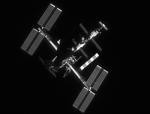 A Visit from Atlantis
28.06.2007
This remarkable image of the space shuttle orbiter Atlantis docked with the International Space Station (ISS) was taken at a range of 190 nautical miles. To record the fast moving pair, last week astronomers...
 Geminids in 2007
3.01.2008
Dust from curious near-Earth asteroid 3200 Phaethon seems to fall from the constellation Gemini in this fisheye skyview. The composite image was recorded over four December nights (12-15) just last year from Ludanyhalaszi, Hungary. Of course, the streaks are meteor trails from the annual Geminids meteor shower.
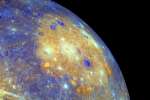 Enhanced Color Caloris
10.07.2008
The sprawling Caloris basin on Mercury is one of the solar system's largest impact basins. Created during the early history of the solar system by the impact of a large asteroid-sized body, the basin spans about 1,500 kilometers and is seen in yellowish hues in this enhanced color mosaic.
|
January February March April May June July August September |
|||||||||||||||||||||||||||||||||||||||||||||||||