
|
You entered: image
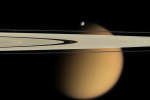 Titan Beyond the Rings
5.05.2009
When orbiting Saturn, be sure to watch for breathtaking superpositions of moons and rings. One such picturesque vista was visible recently to the robot Cassini spacecraft now orbiting Saturn. In 2006 April, Cassini captured Saturn's A and F rings stretching in front of cloud-shrouded Titan.
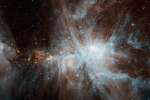 Spitzer s Orion
10.04.2010
Few cosmic vistas excite the imagination like the Orion Nebula, an immense stellar nursery some 1,500 light-years away. Spanning about 40 light-years across the region, this new infrared image from the Spitzer Space...
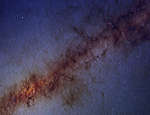 The Galactic Center in Infrared from 2MASS
30.05.2010
The center of our Galaxy is a busy place. In visible light, much of the Galactic Center is obscured by opaque dust. In infrared light, however, dust glows more and obscures less, allowing nearly one million stars to be recorded in the above image.
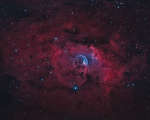 The Bubble Nebula
4.08.2012
Blown by the wind from a massive star, this interstellar apparition has a surprisingly familiar shape. Cataloged as NGC 7635, it is also known simply as The Bubble Nebula. Although it looks delicate, the 10 light-year diameter bubble offers evidence of violent processes at work.
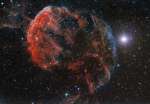 The Elusive Jellyfish Nebula
9.01.2013
Normally faint and elusive, the Jellyfish Nebula is caught in this alluring telescopic view. Drifting near bright star Eta Geminorum, at the foot of a celestial twin, the Jellyfish Nebula is seen dangling tentacles from the bright arcing ridge of emission left of center.
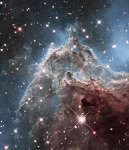 At the Edge of NGC 2174
3.04.2014
This fantastic skyscape lies near the edge of NGC 2174 a star forming region about 6,400 light-years away in the nebula-rich constellation of Orion. It follows mountainous clouds of gas and dust carved...
 The North and South Jupiter
14.09.2016
A wide, looping orbit brought Juno close to Jupiter on August 27. As the spacecraft swung around the giant planet's poles JunoCam acquired these premier direct polar views, a change from the usual nearly equatorial perspective of outbound spacecraft and the telescopes of planet Earth.
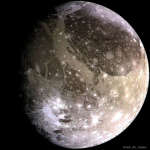 Ganymede: The Largest Moon
14.05.2017
What does the largest moon in the Solar System look like? Jupiter's moon Ganymede, larger than even Mercury and Pluto, has an icy surface speckled with bright young craters overlying a mixture of older, darker, more cratered terrain laced with grooves and ridges.
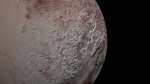 Pluto s Bladed Terrain
5.10.2017
Imaged during the New Horizons spacecraft flyby in July 2015, Pluto's bladed terrain is captured in this close-up of the distant world. The bizarre texture belongs to fields of skyscraper-sized, jagged landforms made almost entirely of methane ice, found at extreme altitudes near Pluto's equator.
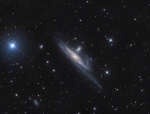 Galaxies in the River
10.05.2018
Large galaxies grow by eating small ones. Even our own galaxy practices galactic cannibalism, absorbing small galaxies that get too close and are captured by the Milky Way's gravity. In fact, the practice...
|
January February March April May June July August September |
|||||||||||||||||||||||||||||||||||||||||||||||||