
|
You entered: image
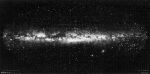 7,000 Stars And The Milky Way
23.05.1998
This panorama view of the sky is really a drawing. It was made in the 1950s under the supervision of astronomer Knut Lundmark at the Lund Observatory in Sweden. To create the picture, draftsmen...
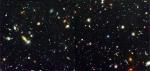 The Hubble Deep Field
7.06.1998
Galaxies like colorful pieces of candy fill the Hubble Deep Field - humanity's most distant yet optical view of the Universe. The dimmest, some as faint as 30th magnitude (about four billion times fainter...
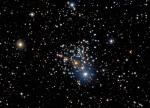 NGC 2266: Old Cluster in the New General Catalog
18.03.2005
The New General Catalog of star clusters and nebulae really isn't so new. In fact, it was published in 1888 - an attempt by J. L. E. Dreyer to consolidate the work of astronomers William, Caroline, and John Herschel along with others into a useful single, complete catalog of astronomical discoveries and measurements.
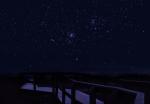 Star Cluster Dreams
13.04.2006
Located some 7,000 light-years away toward the constellation Perseus, this pair of open or galactic star clusters really is visible to the unaided eye and was cataloged in 130 BC by Greek astronomer Hipparchus.
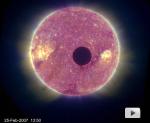 Lunar Transit from STEREO
2.03.2007
A million miles from planet Earth, last weekend the STEREO B spacecraft found itself in the shadow of the Moon. So, looking toward the Sun, extreme ultraviolet cameras onboard STEREO B were able to record a stunning movie of a lunar transit (aka solar eclipse), as the Moon tracked across the solar disk.
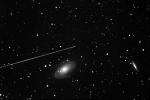 Asteroid and Galaxy
5.04.2007
Apollo class asteroid 2006 VV2 flashed past planet Earth in late March, approaching to within 3.4 million kilometers or about 8.8 times the Earth-Moon distance. Due to the proximity of its orbit to Earth and its estimated diameter of over 1 kilometer, 2006 VV2 is classified as a Potentially Hazardous Asteroid.
 Aurigids from 47 000 Feet
5.09.2007
On September 1, Aurigid meteors filled the sky, in keeping with inovative predictions of an outburst from this historically tentative meteor shower. Astronomers flying at 47,000 feet on a dedicated mission to observer the outburst collected image data for this composite photo of the Aurigids' bright and colorful streaks.
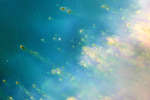 Curious Cometary Knots in the Helix Nebula
13.04.2008
What causes unusual knots of gas and dust in planetary nebulas? Seen also in the Ring Nebula, the Dumbbell Nebula and the Eskimo Nebula, the knots' existence was not initially predicted and their origins are still not well understood.
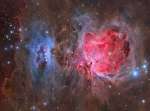 Great Orion Nebulae
23.10.2008
The Great Nebula in Orion, also known as M42, is one of the most famous nebulae in the sky. The star forming region's glowing gas clouds and hot young stars...
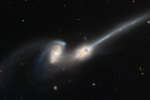 NGC 4676: When Mice Collide
26.04.2009
These two mighty galaxies are pulling each other apart. Known as "The Mice" because they have such long tails, each spiral galaxy has likely already passed through the other. They will probably collide again and again until they coalesce.
|
January February March April May June July August September |
|||||||||||||||||||||||||||||||||||||||||||||||||