
|
You entered: star
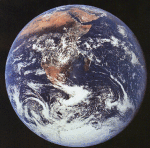 Welcome to Planet Earth
31.01.1999
Welcome to Planet Earth, the third planet from a star named the Sun. The Earth is shaped like a sphere and composed mostly of rock. Over 70 percent of the Earth's surface is water. The planet has a relatively thin atmosphere composed mostly of nitrogen and oxygen.
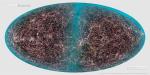 The 2MASS Galaxy Sky
26.06.2005
Are the nearest galaxies distributed randomly? A plot of over one million of the brightest "extended sources" detected by the Two Micron All Sky Survey (2MASS) shows that they are not. The vast majority of these infrared extended sources are galaxies.
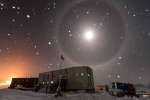 A Blue Moon Halo over Antarctica
11.08.2015
Have you ever seen a halo around the Moon? Such 22 degree rings around the Moon -- caused by ice crystals falling in the Earth's atmosphere -- are somewhat rare. OK, but have you ever seen a blue moon?
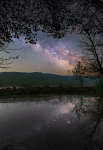 Milky Way in Northern Spring
19.04.2019
A postcard from planet Earth, this springtime night skyscape looks over Alandan lake in the Alborz mountains. Taken after local midnight on April 17, the central Milky Way is rising over the region's southeast horizon. Its luminous track of stars and nebulae along the plane of our galaxy are reflected in the mirror-like lake.
 David N. Schramm, 1945 - 1997
22.12.1997
David N. Schramm effectively combined the very big with the very small. Among his many scientific achievements, Schramm and collaborators successfully used Big Bang cosmology to predict that only three families of elementary particles exist in the universe, which was subsequently confirmed by high energy particle accelerators.
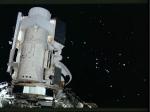 Astro 1 In Orbit
3.12.2005
Fifteen years ago, in December of 1990, the Space Shuttle Orbiter Columbia carried an array of astronomical telescopes high above the Earth's obscuring atmosphere to explore the Universe at ultraviolet and x-ray wavelengths.
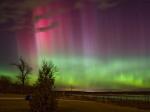 Aurora Over Iowa
18.12.2006
Last Thursday evening, stars were not the only lights in Iowa skies. Spectacular northern lights also shone from the heavens, extending across the midwestern USA and other locations not often graced with auroral displays.
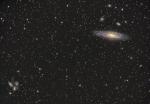 Galaxies in Pegasus
24.11.2007
This wide, sharp telescopic view reveals galaxies scattered beyond the stars near the northern boundary of the high-flying constellation Pegasus. Prominent at the upper right is NGC 7331. A mere 50 million light-years away, the large spiral is one of the brighter galaxies not included in Charles Messier's famous 18th century catalog.
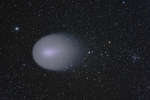 Comet Holmes Over Hungary
5.12.2007
Comet Holmes refuses to fade. The unusual comet that surprisingly brightened nearly a million-fold in late October continues to remain visible to the unaided eye from dark locations. Night to night, Comet 17P/Holmes is slowly gliding through the constellation Perseus, remaining visible to northern observers during much of the night right from sunset.
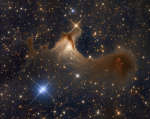 Ghost of the Cepheus Flare
30.10.2010
Spooky shapes seem to haunt this starry expanse, drifting through the night in the royal constellation Cepheus. Of course, the shapes are cosmic dust clouds faintly visible in dimly reflected starlight. Far from your...
|
January February March April May June July August September October |
|||||||||||||||||||||||||||||||||||||||||||||||||