
|
You entered: tail
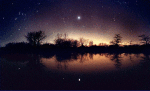 Hyakutake, Venus, Orion, and Pond
18.04.1996
Can you find Comet Hyakutake in the above picture? In this gorgeous photo, the starry night sky of April 9th is pictured with its new comet visitor. In the foreground is a pond with the lights of Kansas City, Missouri on the western horizon. On the upper left, the constellation of Orion is visible.
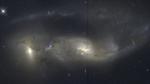 Arp 81: 100 Million Years Later
11.12.2003
From planet Earth, we view this strongly interacting pair of galaxies, cataloged as Arp 81, as they were only about 100 million years after their mutual closest approach. The havoc wreaked by gravity during...
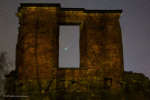 Comet Lovejoy through Morby Castle Ruins
4.12.2013
This new comet is quite photogenic. Comet Lovejoy, discovered only three months ago, was imaged through ruins of ancient MЖrby Castle in Sweden last week sporting a green-glowing coma and tails trailing several degrees.
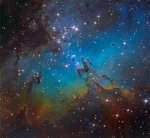 M16 Close Up
9.09.2021
A star cluster around 2 million years young surrounded by natal clouds of dust and glowing gas, M16 is also known as The Eagle Nebula. This beautifully detailed image of the region adopts the colorful Hubble palette and includes cosmic sculptures made famous in Hubble Space Telescope close-ups of the starforming complex.
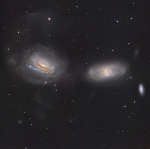 APOD: 2026 May 18 Б Unraveling NGC 3169
18.05.2026
Spiral galaxy NGC 3169 looks to be unraveling like a ball of cosmic yarn. It lies some 70 million light-years away, south of bright star Regulus toward the faint constellation Sextans. Wound up spiral arms are pulled out into sweeping tidal tails as NGC 3169 (left) and neighboring NGC 3166 interact gravitationally.
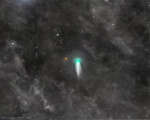 APOD: 2026 August 24 Б Comet 220P in Outburst
24.08.2026
Comet 220P is unexpectedly bright. Normally, periodic Comet 220P/McNaught is so dim that to see it requires a telescope. Two surprising outbursts this year, however, have made it about 20,000 times brighter than usual, so that it is now visible with binoculars and long-duration camera exposures.
 Comet McNaught Over Catalonia
15.01.2007
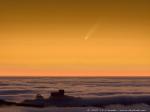
This past weekend Comet McNaught peaked at a brightness that surpassed even Venus. Fascinated sky enthusiasts in the Earth's northern hemisphere were treated to an instantly visible comet head and a faint elongated tail near sunrise and sunset.
 NanoSail D
28.01.2011
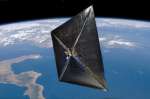
Featured in this artist's illustration, NASA's NanoSail-D finally unfurled a very thin, 10 square meter reflective sail on January 20th, becoming the first solar sail spacecraft in low Earth orbit. Often considered...
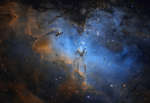 M16 and the Eagle Nebula
15.10.2015
A star cluster around 2 million years young surrounded by natal clouds of dust and glowing gas, M16 is also known as The Eagle Nebula. This beautifully detailed image of the region includes cosmic sculptures made famous in Hubble Space Telescope close-ups of the starforming complex.
 APOD: 2025 September 26 Б A SWAN an ATLAS and Mars
26.09.2025
A new visitor to the inner Solar System, comet C/2025 R2 (SWAN) sports a long ion tail extending diagonally across this almost 7 degree wide telescopic field of view recorded on September 21.
|
January February March April May June July August September October |
|||||||||||||||||||||||||||||||||||||||||||||||||