
|
You entered: tail
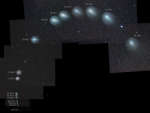 Three Month Composite of Comet Holmes
5.02.2008
How has Comet Holmes changed? Since brightening unexpectedly by nearly one million fold in late October, the last three months have found the coma of Comet 17P/Holmes both expanding and fading. This spectacular composite image shows how the coma and tail of Comet Holmes have changed.
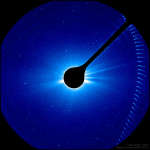 Comet Machholz Approaches the Sun
13.11.2017
Why is Comet Maccholz so depleted of carbon-containing chemicals? Comet 96P/Machholz's original fame derives from its getting closer to the Sun than any other short period comet -- half as close as Mercury -- and doing so every five years.
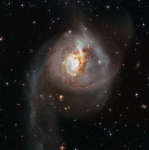 The Clash of NGC 3256
7.06.2018
Marked by an unusually bright central region, swirling dust lanes, and far flung tidal tails, peculiar NGC 3256 is the aftermath of a truly cosmic collision. The 500 million year old clash of two separate galaxies spans some 100 thousand light-years in this sharp Hubble view.
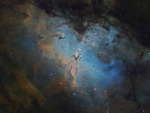 M16 Close Up
10.08.2019
A star cluster around 2 million years young surrounded by natal clouds of dust and glowing gas, M16 is also known as The Eagle Nebula. This beautifully detailed image of the region adopts the colorful Hubble palette and includes cosmic sculptures made famous in Hubble Space Telescope close-ups of the starforming complex.
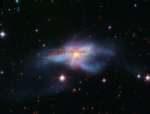 NGC 6240: Merging Galaxies
18.06.2009
NGC 6240 offers a rare glimpse of a cosmic catastrophe in its final throes. The titanic galaxy-galaxy collision is located a mere 400 million light-years away in the constellation Ophiuchus. One of the brightest...
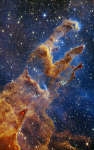 Pillars of Creation
20.10.2022
A now famous picture from the Hubble Space Telescope featured these star forming columns of cold gas and dust light-years long inside M16, the Eagle Nebula, dubbed the Pillars of Creation. This James Webb Space Telescope NIRCam image expands Hubble's exploration of that region in greater detail and depth inside the iconic stellar nursery.
 APOD: 2025 September 18 Б Comet C/2025 R2 SWAN
18.09.2025
A new visitor from the outer Solar System, comet C/2025 R2 (SWAN) also known as SWAN25B was only discovered late last week, on September 11. That's just day before the comet reached perihelion, its closest approach to the Sun.
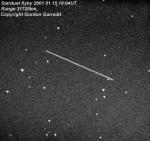 Sail On Stardust
25.01.2001
Spacecraft on long interplanetary voyages often use the planets themselves as gravitational "sling shots" to boost them along their way. Launched in February of 1999 on a historic voyage to a comet, the Stardust spacecraft is no different.
 NGC 1893 and the Tadpoles of IC 410
2.02.2024
This cosmic view shows off an otherwise faint emission nebula IC 410, captured under clear Netherlands skies with telescope and narrowband filters. Above and right of center you can spot two remarkable inhabitants of the interstellar pond of gas and dust, known as the tadpoles of IC 410.
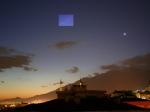 Venus and Comet Pojmanski
3.03.2006
Shining brightly in the east at dawn, Venus dominates the sky in this view over a suburban landscape from Bursa, Turkey. An otherwise familiar scene for astronomer Tunc Tezel, his composite picture of the morning sky recorded on March 2nd also includes a surprise visitor to the inner solar system, Comet Pojmanski.
|
January February March April May June July August September October |
|||||||||||||||||||||||||||||||||||||||||||||||||