
|
You entered: light
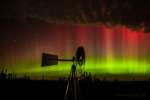 October Aurora in Prairie Skies
5.10.2013
Wind and spaceweather are transformed in this haunting night skyscape. The prairie windmill and colorful auroral display were captured on October 1, from central South Dakota, USA, as a good season for aurora hunters came with longer autumn nights.
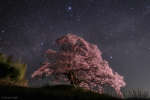 Summer Triangles over Japan
6.05.2015
Have you ever seen the Summer Triangle? The bright stars Vega, Deneb, and Altair form a large triangle on the sky that can be seen rising in the early northern early spring during the morning and rising in the northern fall during the evening.
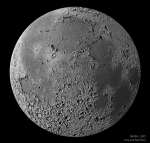 Terminator Moon
15.02.2022
What's different about this Moon? It's the terminators. In the featured image, you can't directly see any terminator -- the line that divides the light of day from the dark of night. That's because the image is a digital composite of 29 near-terminator lunar strips.
 APOD: 2023 April 30 Б Saturns Moon Helene in Color
30.04.2023
Although its colors may be subtle, Saturn's moon Helene is an enigma in any light. The moon was imaged in unprecedented detail in 2012 as the robotic Cassini spacecraft orbiting Saturn swooped to within a single Earth diameter of the diminutive moon.
 APOD: 2024 April 22 Б Moon and Smoke Rings from Mt Etna
22.04.2024
Yes, but can your volcano do this? To the surprise of some, Mt. Etna emits, on occasion, smoke rings. Technically known as vortex rings, the walls of the volcano slightly slow the outside of emitted smoke puffs, causing the inside gas to move faster.
 A December Winter Night
28.12.2024
Orion seems to come up sideways, climbing over a distant mountain range in this deep skyscape. The wintry scene was captured from southern Poland on the northern hemisphere's long solstice night. Otherwise unseen nebulae hang in the sky, revealed by the camera modified to record red hydrogen-alpha light.
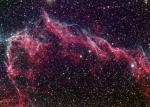 NGC 6992: A Glimpse of the Veil
28.09.2001
After 5,000 years, the gorgeous Veil Nebula is still turning heads. Cataloged as NGC 6992, these glowing filaments of interstellar shocked gas are part of a larger spherical supernova remnant known as the Cygnus Loop or the Veil Nebula -- expanding debris from a star which exploded over 5,000 years ago.
 Blue Stars and Red Pillars
18.07.1997
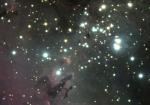
Bright blue stars are still forming in the red pillars of the Eagle Nebula. Made famous by a picture from the Hubble Space Telescope in 1995, the Eagle Nebula shows the dramatic process of star formation. To the upper right of the nebula in the above picture lies the heart of the open cluster M16.
 Henize 70: A Superbubble in the LMC
30.11.1999
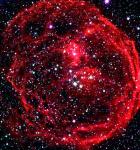
Massive stars -- upwards of tens of times the mass of the Sun - profoundly affect their galactic environment. Churning and mixing the clouds of gas and dust between the stars, they leave their mark on the compositions and locations of future generations of stars and star systems.
 Neptune in Infrared
25.10.1999
Neptune has never looked so clear in infrared light. Neptune is the eighth most distant planet from the Sun, thirty times the Earth-Sun distance. Neptune is the fourth largest planet, almost four times Earth's diameter. Surprisingly, Neptune radiates about twice as much energy as it receives from the Sun.
|
January February March April May June July August September October |
|||||||||||||||||||||||||||||||||||||||||||||||||