
|
You entered: light
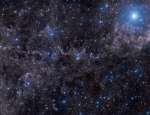 Stars in a Dusty Sky
28.09.2012
Bright star Markab anchors this dusty skyscape. At the top right corner of the frame, Markab itself marks a corner of an asterism known as the Great Square, found within the boundaries of the constellation Pegasus, the flying horse.
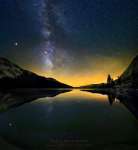 Six Planets from Yosemite
14.06.2018
The five naked-eye planets, Mercury, Venus, Mars, Jupiter and Saturn, have been seen since ancient times to wander the night skies of planet Earth. So it could be remarkable that on this night, standing at the side of a clear, calm lake, six planets can be seen with the unaided eye. Have a look.
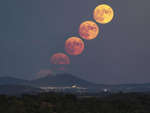 Corn Moon Rising
14.09.2020
A rising moon can be a dramatic sight. A rising Full Corn Moon was captured early this month in time-lapse with a telephoto lens from nearly 30 kilometers away -- making Earth's ascending half-degree companion appear unusually impressive.
 A Harvest Moon over Tuscany
30.09.2023
For northern hemisphere dwellers, September's Full Moon was the Harvest Moon. Reflecting warm hues at sunset, it rises behind cypress trees huddled on a hill top in Tuscany, Italy in this telephoto view from September 28.
 APOD: 2024 January 22 Б Shadows of Mountain and Moon
22.01.2024
Can the Moon and a mountain really cast similar shadows? Yes, but the division between light and dark does not have to be aligned. Pictured, a quarter moon was captured above the mountain Grivola in Italy in early October of 2022.
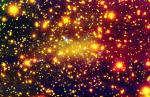 Cepheus 1: Nearby Galaxy Hiding
1.12.1998
Some galaxies are hard to find. Besides being hidden behind the dust and bright foreground stars of our Milky Way Galaxy, recently discovered Cepheus 1 was missed previously because it is so uniformly dim.
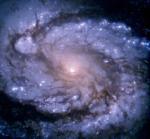 M100: A Grand Design
3.02.2001
Majestic on a truly cosmic scale, M100 is appropriately known as a Grand Design spiral galaxy. A large galaxy of over 100 billion or so stars with well defined spiral arms, it is similar to our own Milky Way.
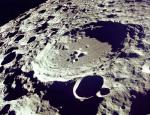 Lunar Farside from Apollo 11
12.03.2003
The far side of the Moon is rough and filled with craters. By comparison, the near side of the Moon, the side we always see, is relatively smooth. Since the Moon is rotation locked to always point the same side toward Earth, humanity has only glimpsed the lunar farside recently -- last century.
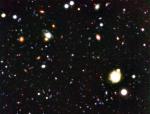 The NTT SUSI Deep Field
15.09.1998
What happens if you point a large telescope at nothing? The above New Technology Telescope SUSI Deep Field photograph isolated a small patch of sky picked to contain no bright objects at all.
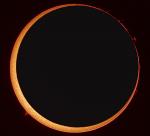 An Annular Solar Eclipse at High Resolution
5.10.2005
On Monday, part of the Sun went missing. The missing piece was no cause for concern -- the Moon was only momentarily in the way. The event was not a total eclipse of the Sun for any Earth-bound sky enthusiast but rather, at best, an annular eclipse, where the Moon blocked most of the Sun.
|
January February March April May June July August September October |
|||||||||||||||||||||||||||||||||||||||||||||||||