
|
You entered: light
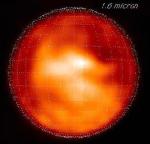 The Surface of Titan
20.08.2000
If sailing the hydrocarbon seas of Titan, beware of gasoline rain. Such might be a travel advisory issued one future day for adventurers visiting Titan, the largest moon of Saturn. New images of Titan's surface were released last week from the Canada-France Hawaii Telescope featuring the finest details yet resolved.
 Sagittarius and the Central Milky Way
5.06.1996
What does the center of our Milky Way Galaxy look like? No one knows! It is not possible to see the Galactic center in light our eyes are sensitive to because the thick dust in the plane of our Galaxy obscures it.
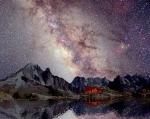 The Milky Way Over Mount Blanc
23.09.2002
Have you ever seen the band of our Milky Way Galaxy? Chances are you have never seen it like this -- nor could you. In a clear sky from a dark location at the right time, a faint band of light is visible across the sky. This band is the disk of our spiral galaxy.
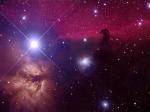 Orions Horsehead Nebula
29.01.2003
The Horsehead Nebula is one of the most famous nebulae on the sky. It is visible as the dark indentation to the red emission nebula seen above and to the right of center in the above photograph. The bright star on the left is located in the belt of the familiar constellation of Orion.
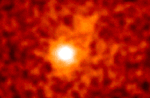 A Quasar in the Gamma Ray Sky
17.11.1996
The bright object in the center of the false color image above is quasar 3C279 viewed in gamma-rays, photons with more than 40 million times the energy of visible light. Like all quasars, 3C279 is a nondescript, faint, starlike object in the visible sky.
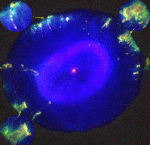 Fliers Around the Blue Snowball Nebula
22.11.1996
Planetary nebulae are strange. First, they are gas clouds and have nothing to do with our Solar System's planets. Next, although hundreds of planetary nebulae have been catalogued and thousands surely exist in our Galaxy, aspects of the formation process are still debated.
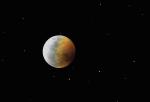 Eclipsed Moon and Stars
23.05.2003
Half-shadowed by the Earth, the Moon takes on a remarkable appearance against a field of stars in this intriguing telephoto picture recorded during a partial phase of last week's lunar eclipse. The picture is not a composite, but it has been digitally enhanced to bring out features covering a large range in brightness.
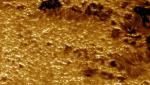 The Suns Surface in 3D
24.06.2003
How smooth is the Sun? The new Swedish 1-m Solar Telescope, deployed in the Canary Islands only last year, allows imaging of objects less than 100-km across on the Sun's surface. When pointed toward the Sun's edge, surface objects now begin to block each other, indicating true three-dimensional information.
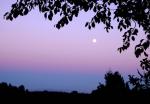 Shadow Rise
22.08.2003
As the Sun sets, the Earth's shadow rises up from the east. The subtle beauty of this daily apparition is often overlooked in favor of the brighter, more colorful western horizon. But while...
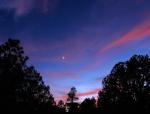 Red, White, and Blue Sky
4.07.2007
Contrasting colors in this beautiful sunset sky were captured on June 30 from Clear Creek Canyon Observatory in central Arizona, USA. The twilight scene includes brilliant Venus as the evening star, with a bright Saturn just above it, shining through thin clouds.
|
January February March April May June July August September October |
|||||||||||||||||||||||||||||||||||||||||||||||||