
|
You entered: light
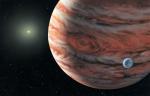 55 Cancri: Familiar Planet Discovered
14.06.2002
Is our Solar System unique? The discovery of a Jupiter-like planet in a Jupiter-like orbit around nearby Sun-like star 55 Cancri, announced yesterday, gives a new indication that planetary systems similar to our Solar System likely exist elsewhere. The planet, discovered by G.
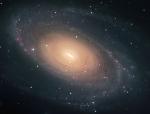 Bright Galaxy M81
20.06.2002
Big and beautiful spiral galaxy M81, in the northern constellation Ursa Major, is one of the brightest galaxies visible in the skies of planet Earth. This superbly detailed view reveals its bright nucleus, grand spiral arms and sweeping cosmic dust lanes with a scale comparable to the Milky Way.
 At the Edge of the Helix
22.04.1996
While exploring the inner edge of the Helix Nebula with the Hubble Space Telescope's Wide Field Planetary Camera 2, astronomers were able to produce this striking image - rich in details of an exotic environment.
 At the Edge of the Helix
20.07.1997
While exploring the inner edge of the Helix Nebula with the Hubble Space Telescope's Wide Field Planetary Camera 2, astronomers were able to produce this striking image - rich in details of an exotic environment.
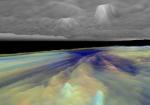 3D View Of Jupiter's Clouds
30.10.1997
Every day is a cloudy day on Jupiter, the Solar System's reigning gas giant. This 3-dimensional visualization presents a simplified model view from between Jovian cloud decks based on imaging and spectral data recorded by the Galileo spacecraft. The separation between the cloud layers and the height variations have been exaggerated.
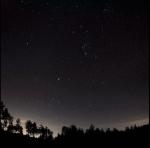 Cold Mountain Sky
4.03.2004
This lovely celestial view is surely a familiar one to winter skygazers in the northern hemisphere. Lights silhouetting the trees are from nearby towns Morganton and Rutherford College, North Carolina, USA. But the scene may also look familiar to attentive fans of the movie Cold Mountain, whose fictional characters discuss this same factual starry sky.
 Two Comets in Southern Skies
27.05.2004
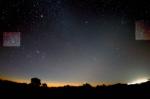
Wielding a very wide-angle lens, astronomer Gordon Garradd was able to capture two naked-eye comets in one picture looking toward the west from Loomberah, New South Wales, Australia. At the far left lies comet C/2002 T7 (LINEAR) and at the far right, comet C/2001 Q4 (NEAT).
 Vega
Vega
23.08.1998
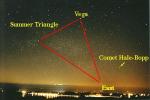
Vega is a bright blue star 25 light years away. Vega is the brightest star in the Summer Triangle, a group of stars easily visible summer evenings in the northern hemisphere. The name Vega...
 A Deep Field In The Southern Sky
2.12.1998
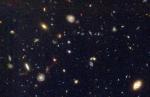
This new deep view of the cosmos is the sequel to the 1995 hit Hubble Space Telescope Deep Field. Billed as the Hubble Deep Field South, it was produced by pointing the space telescope toward a patch of sky in the southern constellation Tucana.
 NGC 3132: The Eight Burst Nebula
14.10.2007
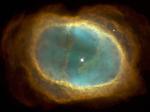
It's the dim star, not the bright one, near the center of NGC 3132 that created this odd but beautiful planetary nebula. Nicknamed the Eight-Burst Nebula and the Southern Ring Nebula, the glowing gas originated in the outer layers of a star like our Sun.
|
January February March April May June July August September October |
|||||||||||||||||||||||||||||||||||||||||||||||||