
|
You entered: planet
 APOD: 2025 September 20 Б Gibbous vs Crescent
20.09.2025
Early risers around planet Earth have enjoyed a shining crescent Moon near brilliant Venus, close to the eastern horizon in recent morning twilight skies. And yesterday, on September 19, skygazers watching from some locations...
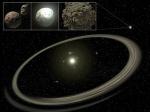 Old Planetary Dust Disks Found by SST
19.10.2004
Why are some older stars surrounded by dust? Observations from the Spitzer Space Telescope by a team led by George Rieke (U. Arizona) were expected to show that young stars, on the order of one million years old, have large dust disks, while relatively older stars, between 10 and 100 million years old, have none.
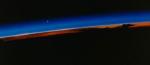 Venus On The Horizon
14.10.1997
The month of October features a sky full of planets, including Venus as the brilliant evening star. Besides the sun and moon, Venus is the brightest object visible in Earth's sky. This month, Venus appears in early evening near the red planet Mars and Mars' red giant rival Antares above the southwestern horizon.
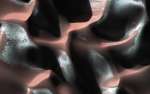 Martian Chiaroscuro
29.08.2020
Deep shadows create dramatic contrasts between light and dark in this high-resolution close-up of the martian surface. Recorded on January 24, 2014 by the HiRISE camera on board the Mars Reconnaissance Orbiter, the scene spans about 1.5 kilometers.
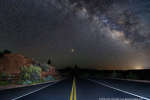 Road to Mars
9.07.2018
What's that light at the end of the road? Mars. This is a good month to point out Mars to your friends and family because our neighboring planet will not only be its brightest in 15 years, it will be visible for much of night.
 Phobos: Moon over Mars
22.03.2024
A tiny moon with a scary name, Phobos emerges from behind the Red Planet in this timelapse sequence from the Earth-orbiting Hubble Space Telescope. Over 22 minutes the 13 separate exposures were captured near the 2016 closest approach of Mars to planet Earth. Martians have to look to the west to watch Phobos rise, though.
 Proxima Centauri: The Closest Star
18.01.2016
Does the closest star to our Sun have planets? No one is sure -- but you can now follow frequent updates of a new search that is taking place during the first few months of this year. The closest star, Proxima Centauri, is the nearest member of the Alpha Centauri star system.
 Full Moon, Full Mars
18.01.2025
On January 13 a Full Moon and a Full Mars were close, both bright and opposite the Sun in planet Earth's sky. In fact Mars was occulted, passing behind the Moon, when viewed from some locations in North America and northwest Africa.
 Mars at the Moon s Edge
24.07.2003
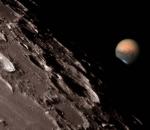
What was that bright "star" near the Moon last week? Mars of course, as the Red Planet wandered near the wanning gibbous Moon early last Thursday morning, passing behind the lunar orb when viewed from some locations in South and Central America, the Carribean, and Florida.
 S is for Venus
7.01.2005
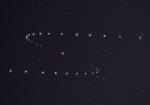
Planet Venus traced out this S shape in Earth's sky during 2004. Following the second planet from the Sun in a series of 29 images recorded from April 3rd through August...
|
January February March April May June July August September October |
|||||||||||||||||||||||||||||||||||||||||||||||||