
|
You entered: planet
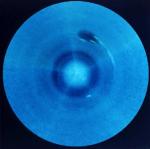 Southern Neptune
29.05.1997
Neptune, the Solar System's outermost gas giant planet, is 30 times farther from the Sun than Earth. Twelve years after a 1977 launch, Voyager 2 flew by Neptune and found surprising activity on a planet that receives only 3 percent as much sunlight as Jupiter.
 Rolling Across the Rocky Plains of Mars
4.10.2010
You stare out across the rocky plains of Mars. Before you, in every direction, is dark sand and bright rock. Although little has changed here for millions of years, no one has ever seen this view before. You are being sent on a long journey to a distant crater, the largest crater in the region.
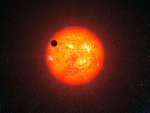 Extrasolar Super Earth Gliese 1214b Might Hold Water
10.09.2013
Might this distant planet hold water? Actually, given how close Gliese 1214b is to its parent star, any water, if it exists, would surely be in the form of steam. In the above artist...
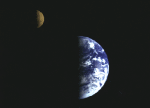 The Earth-Moon System
29.06.1995
A double planet? From 4 million miles away on December 16, 1992, NASA's robot spacecraft Galileo took this picture of the Earth-moon system. The bright, sunlit half of the Earth contrasts strongly with the darker subdued colors of the moon. Our moon is one of the largest moons in the solar system.
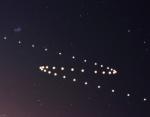 Z is for Mars
22.04.2006
This composite of images spaced about a week apart - from late July 2005 (bottom right) through February 2006 (top left) - traces the retrograde motion of ruddy-colored Mars through planet Earth's night sky. On November 7th, 2005 the Red Planet was opposite the Sun in Earth's sky (at opposition).
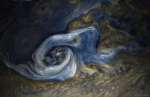 Juno Spots a Complex Storm on Jupiter
28.11.2017
Some storms on Jupiter are quite complex. The swirling storm was captured late last month by the NASA's robotic Juno spacecraft currently orbiting the Solar System's largest planet. The featured image spans about 30,000 kilometers, making this storm system just about as wide as planet Earth.
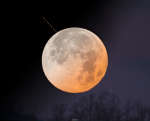 Full Moon, Full Mars
15.12.2022
On December 8 a full Moon and a full Mars were close, both bright and opposite the Sun in planet Earth's sky. In fact Mars was occulted, passing behind the Moon when viewed from some locations across Europe and North America.
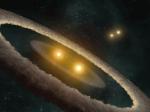 The Four Suns of HD 98800
30.07.2007
How would it look to have four suns in the sky? Planets of the HD 98800 system, if they exist, would experience such a view. HD 98800 is a multiple star system about 150 light years from Earth -- right in our section of the Milky Way Galaxy.
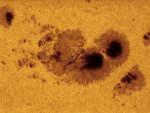 AR1520: Islands in the Photosphere
14.07.2012
Awash in a sea of plasma and anchored in magnetic fields, sunspots are planet-sized, dark islands in the solar photosphere, the bright surface of the Sun. Dark because they are slightly cooler than the surrounding surface, this group of sunspots is captured in a close-up telescopic snapshot from July 11.
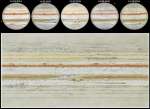 Jupiter Unplugged
2.03.2012
Five hand drawn sketches of Jupiter were used to create this beautifully detailed flat map of the ruling gas giant's turbulent cloud tops. Made with colored pencils at the eyepiece of a 16 inch diameter telescope, the original drawings are about 5 inches (12.5 cm) in diameter.
|
January February March April May June July August September October |
|||||||||||||||||||||||||||||||||||||||||||||||||