
|
You entered: planet
 Jupiter and Saturn Pas de Deux
19.12.2001
Viewed from Earth, the solar system's planets do a cosmic dance that is hard to appreciate on any single night. But consider this well planned animated sequence combining 23 pictures taken at approximately 2 week intervals from June 2000 through May 2001.
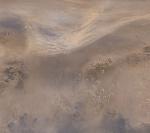 Dust Storm Over Northern Mars
10.07.2003
Almost on cue, as Mars nears it's closest approach to planet Earth in recorded history, ominous seasonal dust storms are beginning to kick up. Observers worry that the activity may presage the development...
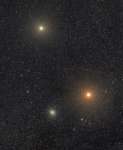 M22 and the Wanderers
11.04.2018
Wandering through the constellation Sagittarius, bright planets Mars and Saturn appeared together in early morning skies over the last weeks. They are captured in this 3 degree wide field-of-view from March 31 in a close celestial triangle with large globular star cluster Messier 22.
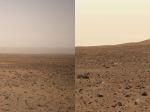 Earth or Mars
12.04.2005
Which image is Earth, and which is Mars? One of the above images was taken by the robot Spirit rover currently climbing Husband Hill on Mars. The other image was taken by a human across the desert south of Morocco on Earth. Both images show vast plains covered with rocks and sand.
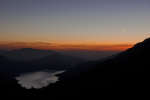 Young Moon Meets Evening Star
1.12.2011
Now appearing as planet Earth's evening star, brilliant Venus shines in western skies at twilight. Standing above a rugged horizon and warm sunset colors, the twilight's celestial beacon was joined last Saturday by a Moon 35 hours young in this gorgeous skyscape.
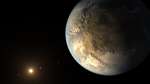 Earth size Kepler 186f
19.04.2014
Planet Kepler-186f is the first known Earth-size planet to lie within the habitable zone of a star beyond the Sun. Discovered using data from the prolific planet-hunting Kepler spacecraft, the distant world orbits...
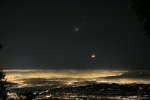 A Happy Sky over Los Angeles
11.11.2017
Sometimes, the sky may seem to smile over much of planet Earth. On this day in 2008, visible the world over, was an unusual superposition of our Moon and the planets Venus and Jupiter.
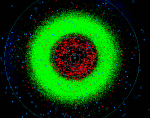 Our Busy Solar System
24.07.2002
Our Solar System is a busy place. Although the major planets get the most press, a swarm of rocks, comets, and asteroids also exist. The above plot shows the placement of known inner Solar System objects on 2002 July 20. The light blue lines indicate the orbits of planets.
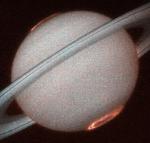 Saturnian Aurora
22.01.1999
Girdling the second largest planet in the Solar System, Saturn's Rings are one of the most spectacular sights for earthbound telescopes. This image from the orbiting Hubble Space Telescope's STIS instrument, offers a striking view of another kind of ring around Saturn - pole encircling rings of ultraviolet aurora.
 Night of the Long Leonid
22.11.2012
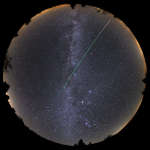
A cosmic grain of sand left the long and colorful trail across this all-sky view. Its grazing impact with planet Earth's atmosphere began at 71 kilometers per second. With the Milky Way stretching...
|
January February March April May June July August September October |
|||||||||||||||||||||||||||||||||||||||||||||||||