
|
You entered: Earth
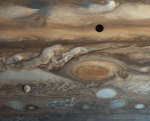 Europa and Jupiter from Voyager 1
5.09.2017
What are those spots on Jupiter? Largest and furthest, just right of center, is the Great Red Spot -- a huge storm system that has been raging on Jupiter possibly since Giovanni Cassini's likely notation of it 352 years ago. It is not yet known why this Great Spot is red.
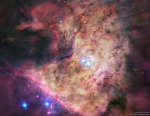 Trapezium: At the Heart of Orion
5.08.2018
Near the center of this sharp cosmic portrait, at the heart of the Orion Nebula, are four hot, massive stars known as the Trapezium. Gathered within a region about 1.5 light-years in radius, they dominate the core of the dense Orion Nebula Star Cluster.
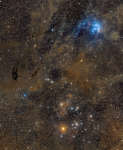 Pleiades to Hyades
6.12.2019
This cosmic vista stretches almost 20 degrees from top to bottom, across the dusty constellation Taurus. It begins at the Pleiades and ends at the Hyades, two star clusters recognized since antiquity in Earth's night sky. At top, the compact Pleiades star cluster is about 400 light-years away.
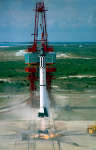 Mercury Redstone 3 Launch
7.05.2021
Sixty years ago, near the dawn of the space age, NASA controllers "lit the candle" and sent Mercury astronaut Alan Shepard arcing into space atop a Redstone rocket. His cramped space capsule was dubbed Freedom 7.
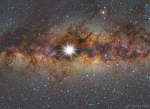 Solstice Sun and Milky Way
21.12.2021
Welcome to December's solstice, first day of winter in the north and summer for the southern hemisphere. Astronomical markers of the seasons, solstice and equinox dates are based on the Sun's place in its annual journey along the ecliptic, through planet Earth's sky.
 The Shadow of Ingenuity s Damaged Rotor Blade
10.02.2024
On January 18, 2024, during its 72nd flight in the thin Martian atmosphere, autonomous Mars Helicopter Ingenuity rose to an altitude of 12 meters (40 feet) and hovered for 4.5 seconds above the Red Planet. Ingenuity's 72nd landing was a rough one though.
 APOD: 2024 February 25 Б A Phoenix Aurora over Iceland
25.02.2024
All of the other aurora watchers had gone home. By 3:30 am in Iceland, on a quiet September night, much of that night's auroras had died down. Suddenly, unexpectedly, a new burst of particles streamed down from space, lighting up the Earth's atmosphere once again.
 APOD: 2025 July 13 Б Planetary Nebula Mz3: The Ant Nebula
13.07.2025
Why isn't this ant a big sphere? Planetary nebula Mz3 is being cast off by a star similar to our Sun that is, surely, round. Why then would the gas that is streaming away create an ant-shaped nebula that is distinctly not round?
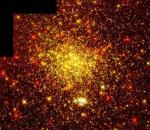 NGC1850: Star Cluster in the LMC
29.07.2000
NGC1850 is a large cluster of stars located a mere 166,000 light-years from Earth in our neighboring galaxy the Large Magellanic Cloud (LMC). The colors in this beautiful Hubble Space Telescope composite image of the cluster reveal different populations of stars.
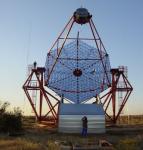 HESS Gamma Ray Telescope
6.09.2002
Most ground-based telescopes with lenses and mirrors are hindered by the Earth's nurturing, protective atmosphere that blurs images and scatters and absorbs light. But this telescope was designed to detect extreme gamma rays - photons with over 100 billion times the energy of visible light - and actually requires the atmosphere to operate.
|
January February March April May June July August September October |
|||||||||||||||||||||||||||||||||||||||||||||||||