
|
You entered: Earth
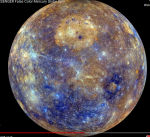 All of Mercury
28.04.2019
Only six years ago, the entire surface of planet Mercury was finally mapped. Detailed observations of the innermost planet's surprising crust began when the robotic have been ongoing since the robotic MESSENGER spacecraft first passed Mercury in 2008 and continued until its controlled crash landing in 2015.
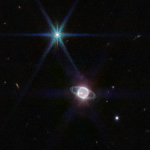 Ringed Ice Giant Neptune
23.09.2022
Ringed, ice giant Neptune lies near the center of this sharp near-infrared image from the James Webb Space Telescope. The dim and distant world is the farthest planet from the Sun, about 30 times farther away than planet Earth.
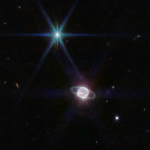 Ringed Ice Giant Neptune
19.08.2023
Ringed ice giant Neptune lies near the center of this sharp near-infrared image from the James Webb Space Telescope. The dim and distant world is the farthest planet from the Sun, about 30 times farther away than planet Earth.
 Encke and the Tadpoles
27.10.2023
History's second known periodic comet is Comet Encke (2P/Encke). As it swings through the inner Solar System, Encke's orbit takes it from an aphelion, its greatest distance from the Sun, inside the orbit of Jupiter to a perihelion just inside the orbit of Mercury.
 APOD: 2024 June 23 Б The Colors of Saturn from Cassini
23.06.2024
What creates Saturn's colors? The featured picture of Saturn only slightly exaggerates what a human would see if hovering close to the giant ringed world. The image was taken in 2005 by the robot Cassini spacecraft that orbited Saturn from 2004 to 2017.
 Ringed Ice Giant Neptune
6.09.2024
Ringed ice giant Neptune lies near the center of this sharp near-infrared image from the James Webb Space Telescope. The dim and distant world is the farthest planet from the Sun, about 30 times farther away than planet Earth.
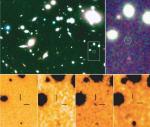 Redshift 10: Evidence for a New Farthest Galaxy
17.03.2004
What's the farthest galaxy known? The answer keeps changing as astronomers compete to find galaxies that top the list. The new claimed record holder is now the faint smudge indicated in the above images by an 8.2-meter Very Large Telescope (VLT) operating in Chile.
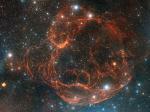 Simeis 147: Supernova Remnant from Palomar
29.11.2005
It's easy to get lost following the intricate filaments in this detailed image of faint supernova remnant Simeis 147. Seen towards the constellation Taurus it covers nearly 3 degrees (6 full moons) on the sky corresponding to a width of 150 light-years at the stellar debris cloud's estimated distance of 3,000 light-years.
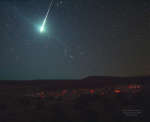 Bright Bolide
11.10.2008
On September 30, a spectacular bolide or fireball meteor surprised a group of amateur astronomers enjoying dark night skies over the Oklahoma panhandle's Black Mesa State Park in the Midwestern US. Flashing past...
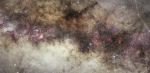 Journey to the Center of the Galaxy
2.07.2012
What wonders lie at the center of our Galaxy? In Jules Verne's science fiction classic A Journey to the Center of the Earth, Professor Liedenbrock and his fellow explorers encounter many strange and exciting wonders.
|
January February March April May June July August September October |
|||||||||||||||||||||||||||||||||||||||||||||||||