
|
You entered: gas
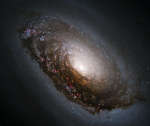 M64: The Sleeping Beauty Galaxy
12.06.2011
The Sleeping Beauty galaxy may appear peaceful at first sight but it is actually tossing and turning. In an unexpected twist, recent observations have shown that the gas in the outer regions of this photogenic spiral is rotating in the opposite direction from all of the stars!
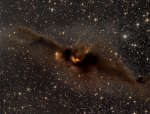 LDN 43: The Cosmic Bat Nebula
30.10.2022
What is the most spook-tacular nebula in the galaxy? One contender is LDN 43, which bears an astonishing resemblance to a vast cosmic bat flying amongst the stars on a dark Halloween night. Located...
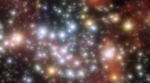 Journey to the Center of the Galaxy
28.07.2018
What wonders lie at the center of our Galaxy? In Jules Verne's science fiction classic A Journey to the Center of the Earth, Professor Liedenbrock and his fellow explorers encounter many strange and exciting wonders.
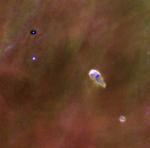 Trapezium: Teardrops in My Skies
15.01.1997
Sometimes the unexpected comes in a familiar shape. In this recently released picture, the seemingly familiar teardrop-shaped object just right of center is actually an unusually situated disk of gas and dust. In fact, the teardrop is about the size of our own Solar System and is racing against time to condense and form planets.
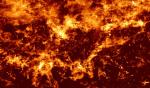 Billows of Smog in the Outer Galaxy
14.01.2001
Our Galaxy is filled with gas. Most of this gas is hydrogen, some is helium, but there is a trace amount of relatively heavy molecules, including carbon monoxide (CO) - a component of smog. The above wide-angle radio CO image shows the incredibly diverse structures that the molecular interstellar medium forms.
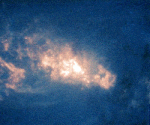 In the Center of Spiral M77
11.09.1996
What is happening in the center of nearby spiral galaxy M77? To find out, astronomers used the Hubble Space Telescope to peer deep into the dusty chaos of this active galactic nucleus in 1994.
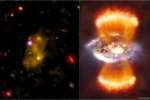 Lyman Alpha Blob
2.07.2009
Dubbed a Lyman-alpha blob, an enormous cloud of hydrogen gas spans several hundred thousand light-years in this remarkable image (left), a composite of x-ray, optical, and infrared data from space and ground based observatories.
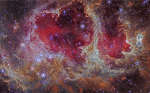 W5: Pillars of Star Formation
15.12.2014
How do stars form? Images of the star forming region W5 like those in the infrared by NASA's Wide Field Infrared Survey Explorer (WISE) satellite provide clear clues with indications that massive stars near the center of empty cavities are older than stars near the edges.
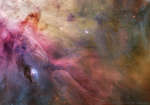 LL Ori and the Orion Nebula
17.02.2018
Stars can make waves in the Orion Nebula's sea of gas and dust. This esthetic close-up of cosmic clouds and stellar winds features LL Orionis, interacting with the Orion Nebula flow. Adrift...
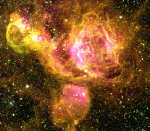 A Star Forming Region in the LMC
23.08.1997
Stars sometimes form in colorful ways. Pictured above is a small region in the nearby LMC galaxy where stars are forming. After a star is born, it may do several things to energize its immediate neighborhood.
|
January February March April May June July August September October |
|||||||||||||||||||||||||||||||||||||||||||||||||