
|
You entered: gas
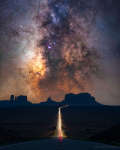 APOD: 2025 November 9 Б Road to the Galactic Center
9.11.2025
Does the road to our galaxy's center go through Monument Valley? It doesn't have to, but if your road does -- take a picture. In this case, the road is US Route 163 and iconic buttes on the Navajo National Reservation populate the horizon.
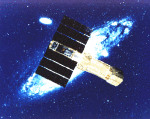 ASCA X-Ray Observatory
20.02.1996
Today marks the third anniversary of the launch of the Advanced Satellite for Cosmology and Astrophysics (ASCA; renamed from Astro D when launched). ASCA, seen here superposed on galaxy M31, is a Japanese satellite for which NASA has provided some scientific equipment. ASCA carries four large-area X-ray telescopes.
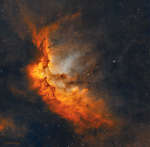 NGC 7380: The Wizard Nebula
14.11.2022
What powers are being wielded in the Wizard Nebula? Gravitation strong enough to form stars, and stellar winds and radiations powerful enough to create and dissolve towers of gas. Located only 8,000 light years away, the Wizard nebula, featured here, surrounds developing open star cluster NGC 7380.
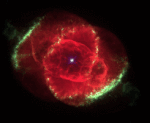 The Cat's Eye Nebula
28.06.1995
Three thousand light years away, a dying star throws off shells of glowing gas. This Hubble Space Telescope image reveals "The Cat's Eye Nebula" to be one of the most complex "planetary nebulae" known.
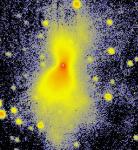 Cold Wind From The Boomerang Nebula
15.10.1997
A cold wind blows from the central star of the Boomerang Nebula. Seen here in a false color image of dust reflected starlight, the nebula lies about 5,000 light-years away. The boomerang shaped...
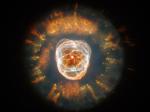 The Eskimo Nebula from Hubble
9.07.2006
In 1787, astronomer William Herschel discovered the Eskimo Nebula. From the ground, NGC 2392 resembles a person's head surrounded by a parka hood. In 2000, the Hubble Space Telescope imaged the Eskimo Nebula. From space, the nebula displays gas clouds so complex they are not fully understood.
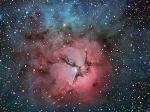 The Trifid Nebula in Stars and Dust
13.08.2007
Unspeakable beauty and unimaginable bedlam can be found together in the Trifid Nebula. Also known as M20, this photogenic nebula is visible with good binoculars towards the constellation of Sagittarius. The energetic processes of star formation create not only the colors but the chaos. The red-glowing gas results from high-energy starlight striking interstellar hydrogen gas.
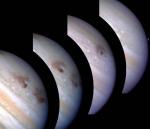 Jupiter Swallows Comet Shoemaker Levy 9
5.11.2000
What happens when a comet encounters a planet? If the planet has a rocky surface, a huge impact feature will form. A giant planet like Jupiter, however, is mostly gas. When Comet Shoemaker-Levy 9 struck Jupiter in 1994, each piece was swallowed into the vast Jovian atmosphere.
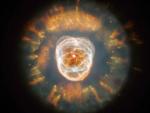 The Eskimo Nebula from Hubble
7.04.2002
In 1787, astronomer William Herschel discovered the Eskimo Nebula. From the ground, NGC 2392 resembles a person's head surrounded by a parka hood. In 2000, the Hubble Space Telescope imaged the Eskimo Nebula. From space, the nebula displays gas clouds so complex they are not fully understood.
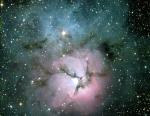 M20: The Trifid Nebula
28.03.2000
Unspeakable beauty and unimaginable bedlam can be found together in the Trifid Nebula. Also known as M20, this photogenic nebula is visible with good binoculars towards the constellation of Sagittarius. The energetic processes of star formation create not only the colors but the chaos. The red-glowing gas results from high-energy starlight striking interstellar hydrogen gas.
|
January February March April May June July August September October |
|||||||||||||||||||||||||||||||||||||||||||||||||