
|
You entered: gas
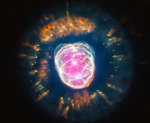 The Eskimo Nebula from Hubble and Chandra
30.07.2013
In 1787, astronomer William Herschel discovered the Eskimo Nebula. From the ground, NGC 2392 resembles a person's head surrounded by a parka hood. In 2000, the Hubble Space Telescope imaged the Eskimo Nebula in visible light, while the nebula was imaged in X-rays by the Chandra X-ray Observatory in 2007.
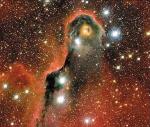 An Unusual Globule in IC 1396
25.03.2002
Is there a monster in IC 1396? Known to some as the Elephant's Trunk Nebula, parts of gas and dust clouds of this star formation region may appear to take on foreboding forms, some nearly human. The only real monster here, however, is a bright young star too far from Earth to hurt us.
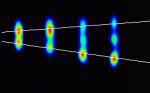 Micro-Quasar GRS1915 Puffs
2.12.1997
On the far side of our Galaxy, gas clouds explode away from a small black hole. This might seem peculiar, as black holes are supposed to attract matter. But material falling toward a black hole collides and heats up, creating an environment similar to a quasar that is far from stable.
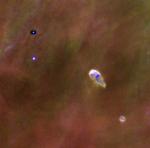 Trapezium: Teardrops in My Skies
28.02.1999
Sometimes the unexpected comes in a familiar shape. In this picture, the seemingly familiar teardrop-shaped object just right of center is actually an unusually situated disk of gas and dust. In fact, the teardrop is about the size of our own Solar System and is racing against time to condense and form planets.
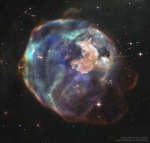 N63A: Supernova Remnant in Visible and X-ray
11.12.2019
What has this supernova left behind? As little as 2,000 years ago, light from a massive stellar explosion in the Large Magellanic Cloud (LMC) first reached planet Earth. The LMC is a close...
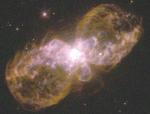 The Hubble 5 Planetary Nebula
19.01.1998
The Hubble Double Bubble Planetary Nebula is bubbling over with excitement. More mundanely known as Hubble 5, this bipolar planetary nebula is being created by a hot wind of particles streaming away from the central star system.
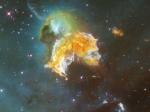 Rampaging Supernova Remnant N63A
8.06.2005
What has this supernova left behind? As little as 2,000 years ago, light from a massive stellar explosion in the Large Magellanic Clouds (LMC) first reached planet Earth. The LMC is a close...
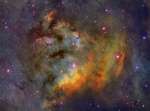 Sharpless 171
18.10.2008
Cosmic pillars of cold molecular gas and clouds of dark dust lie within Sharpless 171, a star-forming region some 3,000 light-years away in the royal constellation Cepheus. This tantalizing false-color skyscape spans about 20 light-years across the nebula's bright central region.
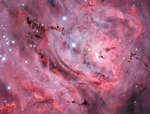 The Deep Lagoon
29.07.2015
Ridges of glowing interstellar gas and dark dust clouds inhabit the turbulent, cosmic depths of the Lagoon Nebula. Also known as M8, The bright star forming region is about 5,000 light-years distant.
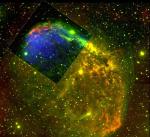 NGC 6888: X Rays in the Wind
16.10.2003
NGC 6888, also known as the Crescent Nebula, is a cosmic bubble of interstellar gas about 25 light-years across. Created by winds from the bright, massive star seen near the center of this composite image, the shocked filaments of gas glowing at optical wavelengths are represented in green and yellowish hues.
|
January February March April May June July August September October |
|||||||||||||||||||||||||||||||||||||||||||||||||