
|
You entered: image
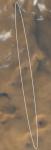 Mars Polar Lander Target Ellipse
4.12.1999
South is up in this recent composite color picture of Mars Polar Lander's target region near the Martian South Pole taken on November 28. Imaged by the orbiting Mars Global Surveyor's wide angle camera, the area covered is 105 kilometers across with the expected landing ellipse superposed.
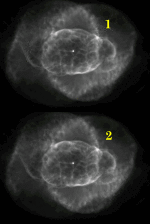 The Incredible Expanding Cats Eye
16.09.1999
Watch closely. As this animation blinks between two Hubble Space Telescope images of NGC 6543 - the first from 1994 and the second from 1997 - the intricate filaments of this nebula are seen to shift. The shift is due to the actual expansion of this gaseous shroud shed by a dying star!
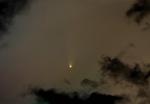 Comet McNaught Heads for the Sun
5.01.2007
Early morning risers with a clear and unobstructed eastern horizon can enjoy the sight of Comet McNaught (C/2006 P1) in dawn skies over the next few days. Discovered in August by R. H. McNaught...
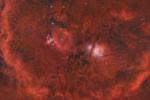 Orion s Cradle
25.01.2007
Cradled in glowing hydrogen, stellar nurseries in Orion lie at the edge of a giant molecular cloud some 1,500 light-years away. This breath-taking view spans about 13 degrees across the center of the well-known constellation with the Great Orion Nebula, the closest large star forming region, just right of center.
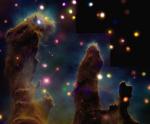 APOD: 2007 February 24- X rays and the Eagle Nebula
24.02.2007
The premier Chandra X-ray Observatory images of M16, the Eagle Nebula, show many bright x-ray sources in the region. Most of the x-ray sources are energetic young stars. They are seen here as colored spots superimposed on the Hubble's well-known optical view of M16's light-year long Pillars of Creation.
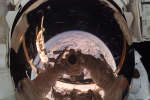 Orbiting Astronaut Reflects Earth
23.01.2008
Astronaut self-portraits can be particularly interesting. Visible in the above picture, working in from the outer borders, are the edges of the reflecting helmet of a space suit, modules of the International Space Station (ISS), the Earth, the arms of Expedition 15 astronaut Clay Anderson, and the digital camera used to snap the image.
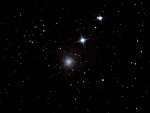 Globular Cluster NGC 2419
23.01.2009
Of three objects prominent in this thoughtful telescopic image, a view toward the stealthy constellation Lynx, two (the spiky ones) are nearby stars. The third is the remote globular star cluster NGC 2419, at distance of nearly 300,000 light-years.
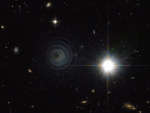 An Extraordinary Spiral from LL Pegasi
14.09.2010
What created the strange spiral structure on the left? No one is sure, although it is likely related to a star in a binary star system entering the planetary nebula phase, when its outer atmosphere is ejected.
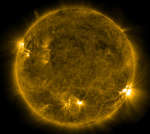 Equinox and the Iron Sun
23.09.2010
Today, the Sun crosses the celestial equator heading south at 03:09 Universal Time. Known as an equinox, this astronomical event marks the first day of autumn in the northern hemisphere and spring in the south. Equinox means equal night.
 Sunspot Group 1429 and the Distant Sun
19.03.2012
What's that on the Sun? Over the past two weeks, one of the most energetic sunspot regions of recent years crossed the face of the Sun. Active Region 1429, visible above...
|
January February March April May June July August September |
|||||||||||||||||||||||||||||||||||||||||||||||||