
|
You entered: image
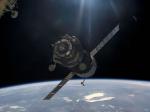 A Soyuz Spacecraft Approaches the Space Station
1.11.2005
Last month, a Soyuz TMA-7 spacecraft docked with the International Space Station. The spacecraft was launched a few days earlier from the Baikonur Cosmodrome in Kazakhstan. Pictured above, the approaching Soyuz spacecraft carried the new Expedition 12 crew to the Earth-orbiting International Space Station (ISS), as well as fee-paying spaceflight participant.
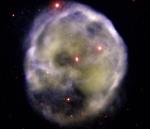 NGC 246 and the Dying Star
18.04.2006
Appropriately nicknamed "the Skull Nebula", planetary nebula NGC 246 really does surround a dying star some 1,600 light-years away in the constellation Cetus. Expelled over a period of thousands of years, the lovely, intricate nebula is the outer atmosphere of a once sun-like star.
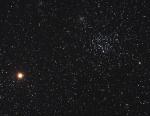 Mars and the Star Clusters
19.04.2006
This evening's skyscape includes a view similar to this one, recorded in western skies on April 16 - an orange-hued planet Mars wandering near rich open star cluster M35. Also notable is fainter star cluster NGC 2158, just above and left of M35.
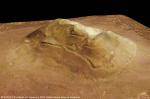 Mars Express Close Up of the Face on Mars
25.09.2006
Wouldn't it be fun if clouds were turtles? Wouldn't it be fun if the laundry on the bedroom chair was a friendly monster? Wouldn't it be fun if rock mesas on Mars were faces or interplanetary monuments? Clouds, though, are small water droplets, floating on air.
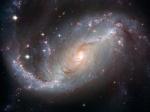 Barred Spiral Galaxy NGC 1672
18.04.2007
Many spiral galaxies have bars across their centers. Even our own Milky Way Galaxy is thought to have a modest central bar. Prominently barred spiral galaxy NGC 1672, pictured above, was captured in spectacular detail in this recently released image taken by the orbiting Hubble Space Telescope.
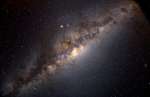 The Milky Way at 5000 Meters
4.01.2008
Climb up to 5000 meters (16,500 feet) above sea level, near Cerro Chajnantor in the northern Chilean Andes, and your night sky could encompass this cosmic vista. Recorded from that high and dry locale, the spectacular fish-eye image features the myriad stars and sprawling dust clouds of our Milky Way Galaxy.
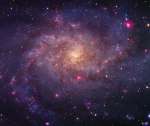 Bright Nebulae in M33
17.10.2009
Gorgeous spiral galaxy M33 seems to have more than its fair share of bright emission nebulae. In fact, narrow-band and broad-band image data are combined in this beautifully detailed composite to trace the reddish emission nebulae, star forming HII regions, sprawling along loose spiral arms that wind toward the galaxy's core.
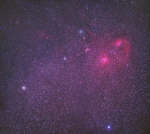 Deep Auriga
5.03.2010
The plane of our Milky Way Galaxy runs right through Auriga, the Charioteer. A good part of the ancient northern constellation's rich collection of nebulae and star clusters is featured in this expansive, 10 degree wide skyscape. Bright star Elnath lies near the bottom right, linking Auriga to another constellation, Taurus, the Bull.
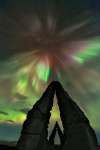 Aurora Over RaufarhЖfn
30.04.2012
It was all lined up even without the colorful aurora exploding overhead. If you follow the apex line of the recently deployed monuments of Arctic Henge in RaufarhЖfn in northern Iceland from this vantage point, you will see that they point due north.
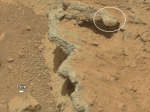 An Ancient Stream Bank on Mars
2.10.2012
Fresh evidence of an ancient stream has been found on Mars. The robotic rover Curiosity has run across unusual surface features that carry a strong resemblance to stream banks on Earth. Visible in the above image, for example, is a small overhanging rock ledge that was quite possibly created by water erosion beneath.
|
January February March April May June July August September |
|||||||||||||||||||||||||||||||||||||||||||||||||