
|
You entered: stars
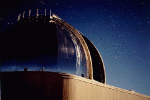 IRTF: Scanning the Infrared Skies
4.09.1996
Above, NASA's Infrared Telescope Facility (IRTF) poses in front of a starry background. Located on top of Hawaii's towering volcano Mauna Kea, the IRTF is the premier telescope for observing in near infrared light. This 3-meter telescope was established in 1979 and spends about half its time observing Solar System objects.
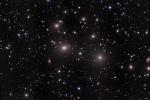 The Perseus Cluster of Galaxies
30.12.2005
Here is one of the largest objects that anyone will ever see on the sky. Each of these fuzzy blobs is a galaxy, together making up the Perseus Cluster, one of the closest clusters of galaxies. The cluster is seen through a foreground of faint stars in our own Milky Way Galaxy.
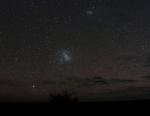 Magellanic Morning
9.08.2006
This early morning skyscape recorded near Winton, Queensland, Australia, looks toward the southeast. Low clouds are seen in silhouette against the first hints of sunlight, while two famous cosmic clouds, the Clouds of Magellan, also hover in the brightening sky.
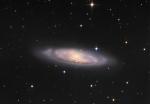 Messier 65
1.06.2007
M65 is a big, beautiful spiral galaxy, the sixty-fifth object in the famous astronomical catalog compiled by 18th century cosmic tourist Charles Messier. It's also a member of a picturesque trio of large spiral galaxies known as the Leo Triplet, about 35 million light-years away.
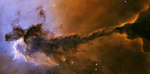 The Fairy of Eagle Nebula
9.12.2007
The dust sculptures of the Eagle Nebula are evaporating. As powerful starlight whittles away these cool cosmic mountains, the statuesque pillars that remain might be imagined as mythical beasts. Pictured above is one of several striking dust pillars of the Eagle Nebula that might be described as a gigantic alien fairy.
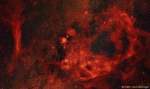 The Gum Nebula
22.08.2009
Named for Australian astronomer Colin Stanley Gum (1924-1960), The Gum Nebula is so large and close it is actually hard to see. In fact, we are only about 450 light-years from the front edge and 1,500 light-years from the back edge of this cosmic cloud of glowing hydrogen gas.
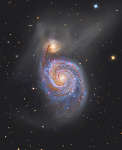 M51: The Whirlpool Galaxy
2.06.2012
Follow the handle of the Big Dipper away from the dipper's bowl until you get to the handle's last bright star. Then, just slide your telescope a little south and west and you might find this stunning pair of interacting galaxies, the 51st entry in Charles Messier famous catalog.
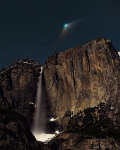 APOD: 2023 February 21 Б Comet ZTF over Yosemite Falls
21.02.2023
They are both falling. The water in Yosemite Falls, California, USA, is falling toward the Earth. Comet ZTF is falling toward the Sun. This double cosmic cascade was captured late last month as fading Comet C/2022 E3 (ZTF) had just passed its closest to planet Earth. The orange star just over the falls is Kochab.
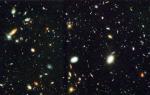 The Hubble Deep Field
1.09.2002
Galaxies like colorful pieces of candy fill the Hubble Deep Field - one of humanity's most distant optical views of the Universe. The dimmest, some as faint as 30th magnitude (about four billion times...
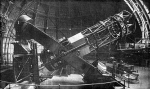 The Hooker Telescope on Mt. Wilson
1.07.1995
In the 1920s, pictures from the Hooker Telescope on Mt. Wilson fundamentally changed our understanding of the cosmos. Astronomer Edwin Hubble, using photographs he took with this telescope, demonstrated that the objects his contemporaries called "spiral nebulae" were actually huge systems of stars - spiral galaxies, similar to our own Milky Way galaxy but incredibly distant.
|
January February March April May June July August September October |
|||||||||||||||||||||||||||||||||||||||||||||||||