
|
You entered: stars
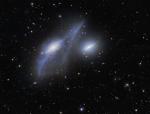 Markarian s Eyes
8.06.2007
Across the heart of the Virgo Galaxy Cluster lies a string of galaxies known as Markarian's Chain. Prominent in Markarian's Chain are these two interacting galaxies, NGC 4438 (left) and NGC 4435 - also known as The Eyes.
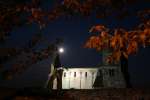 Equinox and Harvest Moon
24.09.2010
Did you enjoy the moonlight last night? The Full Moon closest to autumnal equinox and the beginning of Fall is traditionally known as the Harvest Moon, rising opposite the Sun and illuminating fields at harvest time after sunset. This year's northern hemisphere autumnal equinox occurred yesterday, September 23rd, at 03:09 Universal Time.
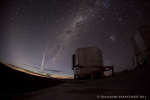 Comet Lovejoy over Paranal
28.12.2011
Comet Lovejoy (C/2011 W3) survived its close encounter with the Sun earlier this month, taking its place among wonders of the southern skies just in time for Christmas. Seen here before sunrise from Paranal Observatory in Chile, the sungrazing comet's tails stretch far above the eastern horizon.
 Nocturnal: Scenes from the Southern Night
6.08.2012
Have you ever seen the night sky change? It does -- sometimes in beautiful and unexpected ways. To see it, though, usually requires patience. The above award winning video shows several of the possible changes in dramatic fashion with a time lapse video.
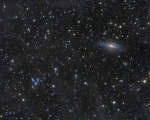 Galaxies in Pegasus
23.10.2014
This wide, sharp telescopic view reveals galaxies scattered beyond the stars and faint dust nebulae of the Milky Way at the northern boundary of the high-flying constellation Pegasus. Prominent at the upper right is NGC 7331.
 Galaxies from the Altiplano
13.10.2016
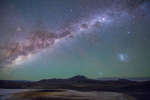
The central bulge of our Milky Way Galaxy rises over the northern Chilean Atacama altiplano in this postcard from planet Earth. At an altitude of 4500 meters, the strange beauty of the desolate landscape could almost belong to another world though.
 Mercury Meets Crescent Venus
29.05.2020
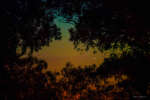
That's not a bright star and crescent Moon caught between branches of a eucalyptus tree. It's Venus in a crescent phase and Mercury. Near the western horizon after sunset, the two inner planets closely shared this telescopic field of view on May 22, seen from a balcony in Civitavecchia, Italy.
 APOD: 2024 March 20 Б The Eyes in Markarians Galaxy Chain
20.03.2024
Across the heart of the Virgo Galaxy Cluster lies a string of galaxies known as Markarian's Chain. Prominent in Markarian's Chain are these two interacting galaxies, NGC 4438 (left) and NGC 4435 - also known as The Eyes.
 Halos Around the Ring Nebula
22.09.1999
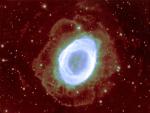
What's happened to the Ring Nebula? The familiar Ring that can be seen with a small back-yard telescope takes on a new look when viewed in dim light. The above recently-released, false-color image...
 Space Station and Space Shuttle: Backyard View
12.10.2001
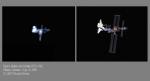
Knowing when and where to look, many enthusiastic sky gazers have been able to spot the International Space Station (ISS) as a bright star streaking through the twilight. But with a digital camera and a small telescope, recognizable images are possible too.
|
January February March April May June July August September October |
|||||||||||||||||||||||||||||||||||||||||||||||||