
|
You entered: stars
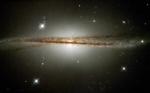 Warped Spiral Galaxy ESO 510 13
7.06.2003
How did spiral galaxy ESO 510-13 get bent out of shape? The disks of many spirals are thin and flat, but not solid. Spiral disks are loose conglomerations of billions of stars and diffuse gas all gravitationally orbiting a galaxy center.
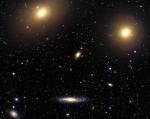 In the Center of the Virgo Cluster
4.08.2003
The Virgo Cluster of Galaxies is the closest cluster of galaxies to our Milky Way Galaxy. The Virgo Cluster is so close that it spans more than 5 degrees on the sky - about 10 times the angle made by a full Moon.
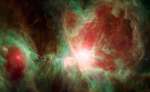 Spitzer s Orion
17.09.2011
Few cosmic vistas excite the imagination like the Orion Nebula, an immense stellar nursery some 1,500 light-years away. This stunning false-color view spans about 40 light-years across the region, constructed using infrared data from the Spitzer Space Telescope.
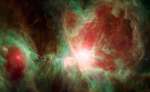 Spitzer s Orion
15.01.2014
Few cosmic vistas excite the imagination like the Orion Nebula, an immense stellar nursery some 1,500 light-years away. This stunning false-color view spans about 40 light-years across the region, constructed using infrared data from the Spitzer Space Telescope.
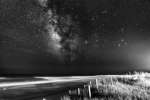 Shoreline of the Universe
20.09.2014
Against dark rifts of interstellar dust, the ebb and flow of starlight along the Milky Way looks like waves breaking on a cosmic shore in this night skyscape. Taken with a digital camera from...
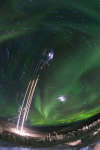 A Night at Poker Flat
29.01.2015
Four NASA suborbital sounding rockets leapt into the night on January 26, from the University of Alaska's Poker Flat Research Range. This time lapse composite image follows all four launches of the small, multi-stage rockets to explore winter's mesmerizing, aurora-filled skies.
 Giant Galaxies in Pavo
23.06.2023
Over 500,000 light years across, NGC 6872 (top right) is a truly enormous barred spiral galaxy, at least 5 times the size of our own very large Milky Way. The appearance of this giant galaxy's distorted and stretched out spiral arms suggests the magnificent wings of a giant bird.
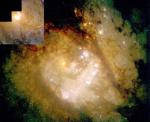 In the Center of Spiral Galaxy M83
6.11.2001
What's happening at the center of spiral galaxy M83? Just about everything, from the looks of it. M83, visible in the inset image on the upper left, is one of the closest spiral galaxies to our own Milky Way Galaxy and from a distance of 15 million light-years, appears to be relatively normal.
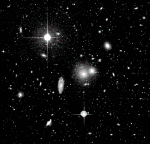 The Hydra Cluster of Galaxies
1.08.1996
You are flying through space and come to ... the Hydra Cluster of Galaxies. Listed as Abell 1060, the Hydra Cluster contains well over 100 bright galaxies. Clusters of galaxies are the largest gravitationally-bound objects in the universe.
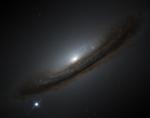 Supernova 1994D and the Unexpected Universe
30.12.1998
Far away, long ago, a star exploded. Supernova 1994D, visible as the bright spot on the lower left, occurred in the outskirts of disk galaxy NGC 4526. Supernova 1994D was not of interest for how different it was, but rather for how similar it was to other supernovae.
|
January February March April May June July August September October |
|||||||||||||||||||||||||||||||||||||||||||||||||