
|
You entered: Jupiter
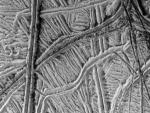 Cracks and Ridges on Europa
10.03.1998
Which way to the interstate? What appears to be a caricature of a complex highway system on Earth is actually a system of ridges and cracks on the icy surface of Jupiter's moon Europa. The distance between parallel ridges in the above photograph is typically about 1 kilometer.
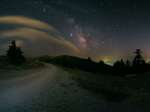 Milky Way Road Trip
5.09.2008
In search of planets and the summer Milky Way, astronomer Tunç Tezel took an evening road trip. Last Saturday, after driving the winding road up Uludag, a mountain near Bursa, Turkey, he was rewarded by this beautiful skyview to the south.
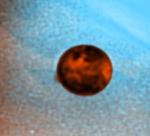 Eruption on Io
23.06.1997
There it goes again. Gas and rock were catapulted hundreds of kilometers into space as Jupiter's most volatile moon, Io, showed yet another impressive volcanic display in this just-released photograph by the Hubble Space Telescope.
 Mysterious Features on Ganymede
9.12.1997
Where is the rest of the circle? Jupiter's largest moon Ganymede has some truly unusual terrain, including the pictured half circle above cut by nearly parallel curves. Full circles can be easily explained by impact craters, but partial circles imply that some resurfacing has occurred since the original impact.
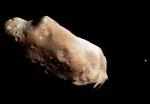 Ida and Dactyl: Asteroid and Moon
7.08.1999
This asteroid has a moon! The robot spacecraft Galileo currently exploring the Jovian system, encountered and photographed two asteroids during its long journey to Jupiter. The second asteroid it photographed, Ida, was discovered to have a moon which appears as a small dot to the right of Ida in this picture.
 Wanderers
29.04.2018
How far out will humanity explore? If this video's fusion of real space imagery and fictional space visualizations is on the right track, then at least the Solar System. Some of the video...
 The Galaxy, the Planet, and the Apple Tree
2.07.2020
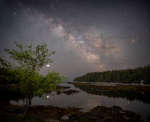
The Old Astronomer's Milky Way arcs through this peaceful northern sky. Against faint, diffuse starlight you can follow dark rifts of interstellar dust clouds stretching from the galaxy's core. They lead toward bright star Antares at the right, almost due south above the horizon. The brightest beacon in the twilight is Jupiter, though.
 Closeup of an Io Volcano
4.08.1995
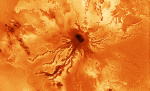
In 1979, one of NASA's Voyager spacecraft made a spectacular and unexpected discovery. Io, the innermost Galilean moon of Jupiter, was covered with volcanoes and some of them were erupting! In all, Voyager 1 observed nine volcanic eruptions during its encounter with the moon.
 Star Clouds over Arizona
24.04.2006
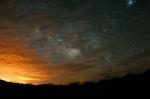
The clouds in the foreground are much different than the clouds in the background. In the foreground are a photogenic deck of Earth-based water clouds. The long exposure used to create the above photograph makes the light from the left, reflected from Phoenix, Arizona, USA, appear like a sunset.
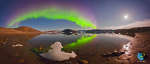 Aurora Over Greenland
23.08.2011
This aurora arched from horizon to horizon. During the current Shelios expedition to observe and learn about the northern lights, the sky last weekend did not disappoint. After sunset and some careful photographic planning, the above image was taken from the expedition's Qaleraliq campsite in southern Greenland.
|
January February March April May June July August September October |
|||||||||||||||||||||||||||||||||||||||||||||||||