
|
You entered: arcs
 When Vega is North
7.05.2015
In only about 12,000 years Vega will be the North Star, the closest bright star to our fair planet's North Celestial Pole. By then, when you fix your camera to a tripod...
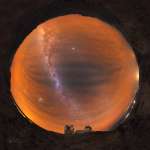 Milky Way vs Airglow Australis
16.05.2018
Captured last week after sunset on a Chilean autumn night, an exceptional airglow floods this allsky view from Las Campanas Observatory. The airglow was so intense it diminished parts of the Milky Way as it arced horizon to horizon above the high Atacama desert.
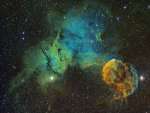 The Elusive Jellyfish Nebula
15.05.2010
Normally faint and elusive, the Jellyfish Nebula is caught in this alluring, false-color, telescopic view. Flanked by two bright stars, Mu and Eta Geminorum, at the foot of a celestial twin, the Jellyfish Nebula is the brighter arcing ridge of emission with dangling tentacles below and right of center.
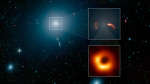 The Galaxy, the Jet, and a Famous Black Hole
14.04.2021
Bright elliptical galaxy Messier 87 (M87) is home to the supermassive black hole captured by planet Earth's Event Horizon Telescope in the first ever image of a black hole. Giant of the Virgo...
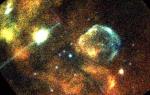 XMM-Newton First Light: X-Rays From The LMC
10.02.2000
Recently the European Space Agency released this and other spectacular "first light" pictures from its new orbiting x-ray observatory, christened XMM-Newton. A churning region of star birth and death in our small neighboring galaxy, the Large Magellanic Cloud (LMC), this field was one of several chosen to test out XMM-Newton's x-ray imaging capabilities.
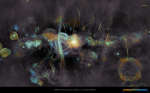 The Galactic Center in Radio from MeerKAT
1.02.2022
What's happening at the center of our galaxy? It's hard to tell with optical telescopes since visible light is blocked by intervening interstellar dust. In other bands of light, though, such as radio, the galactic center can be imaged and shows itself to be quite an interesting and active place.
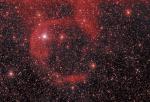 Alpha Cam: Runaway Star
23.11.2006
Runaway stars are massive stars traveling rapidly through interstellar space. Like a ship plowing through cosmic seas, runaway star Alpha Cam has produced this graceful arcing bow wave or bow shock - moving at over 60 kilometers per second and compressing the interstellar material in its path.
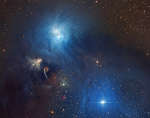 Stars and Dust in Corona Australis
7.01.2015
Cosmic dust clouds and young, energetic stars inhabit this telescopic vista, less than 500 light-years away toward the northern boundary of Corona Australis, the Southern Crown. The dust clouds effectively block light from more distant background stars in the Milky Way.
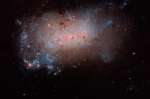 NGC 4449: Close up of a Small Galaxy
13.07.2017
(xxxedit and linkxxx) Grand spiral galaxies often seem to get all the glory. Their young, blue star clusters and pink star forming regions along sweeping spiral arms are guaranteed to attract attention. But small irregular galaxies form stars too, like NGC 4449, about 12 million light-years distant.
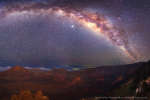 The Milky Way Over Mauna Kea
26.01.2009
Have you ever seen the band of our Milky Way Galaxy? In a clear sky from a dark location at the right time, a faint band of light becomes visible across the sky. Soon after your eyes become dark adapted, you might spot the band for the first time. It may then become obvious.
|
January February March April May June July August September |
|||||||||||||||||||||||||||||||||||||||||||||||||