
|
You entered: arcs
 International Space Station: Find the Astronaut
2.12.2008
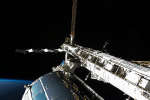
Where's the astronaut? Somewhere in this impressive array of International Space Station (ISS) hardware, astronaut Steve Bowen can be found upgrading and cleaning key parts of Earth's most prominent orbital outpost. Astronaut...
 Comet Lovejoy and the ISS
31.12.2011
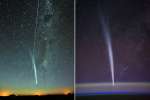
On December 24, Comet Lovejoy rose in dawn's twilight, arcing above the eastern horizon, its tails swept back by the solar wind and sunlight. Seen on the left is the comet's early morning appearance alongside the southern Milky Way from the town of Intendente Alvear, La Pampa province, Argentina.
 Planetary Systems Now Forming in Orion
22.12.2009
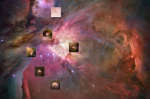
How do planets form? To help find out, the Hubble Space Telescope was tasked to take a detailed look at one of the more interesting of all astronomical nebulae, the Great Nebula in Orion.
 Sharpless 249 and the Jellyfish Nebula
7.03.2019
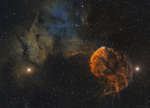
Normally faint and elusive, the Jellyfish Nebula is caught in this alluring telescopic field of view. The entire scene is a two panel mosaic constructed using narrowband image data, with emission from sulfur, hydrogen and oxygen atoms shown in red, green and blue hues.
 APOD: 2023 June 18 Б Saturns Northern Hexagon
18.06.2023
Why would clouds form a hexagon on Saturn? Nobody is sure. Originally discovered during the Voyager flybys of Saturn in the 1980s, nobody has ever seen anything like it anywhere else in the Solar System.
 Chasing the ISS
4.06.2008
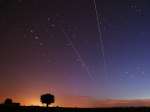
Bathed in sunlight, the International Space Station (ISS) arced through the evening sky above the town of Lauffen in southern Germany on May 31st. The timing of the bright passage was about 10 minutes after the launch of the Space Shuttle Discovery on the STS-124 mission from Kennedy Space Center, Florida, in the southeastern US.
 Zeta Oph: Runaway Star
5.07.2015
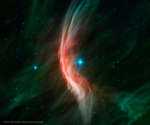
Like a ship plowing through cosmic seas, runaway star Zeta Ophiuchi produces the arcing interstellar bow wave or bow shock seen in this stunning infrared portrait. In the false-color view, bluish Zeta...
 The Jellyfish and Mars
19.05.2021
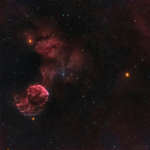
Normally faint and elusive, the Jellyfish Nebula is caught in this alluring scene. In the telescopic field of view two bright yellowish stars, Mu and Eta Geminorum, stand just below and above the Jellyfish Nebula at the left. Cool red giants, they lie at the foot of the celestial twin.
 Giant Cluster Bends, Breaks Images
14.06.1998
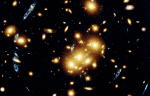
What are those strange blue objects? Many are images of a single, unusual, beaded, blue, ring-like galaxy which just happens to line-up behind a giant cluster of galaxies. Cluster galaxies here appear yellow and -- together with the cluster's dark matter -- act as a gravitational lens.
 Stars and Dust Across Corona Australis
12.09.2013
Cosmic dust clouds sprawl across a rich field of stars in this sweeping telescopic vista near the northern boundary of Corona Australis, the Southern Crown. Less than 500 light-years away the dust clouds effectively block light from more distant background stars in the Milky Way.
|
January February March April May June July August September |
|||||||||||||||||||||||||||||||||||||||||||||||||