
|
You entered: Earth
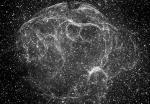 Simeis 147: Supernova Remnant
30.08.2002
It's easy to get lost following the intricate filaments in this stunningly detailed image of faint supernova remnant Simeis 147. Seen towards the constellation Taurus it covers nearly 3 degrees (6 full moons)...
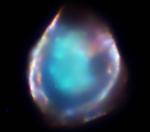 DEM L71: When Small Stars Explode
14.03.2003
Large, massive stars end their furious lives in spectacular supernova explosions -- but small, low mass stars may encounter a similar fate. In fact, instead of simply cooling off and quietly fading away, some white...
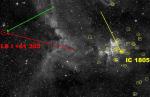 Microquasar in Motion
16.09.2004
Microquasars, bizarre binary star systems, generating high-energy radiation and blasting out jets of particles at nearly the speed of light, live in our Milky Way galaxy. The energetic microquasar systems seem to consist...
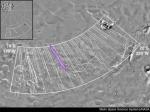 Landing At The Martian South Pole
1.12.1999
The latest invader from Earth, the Mars Polar Lander (MPL) spacecraft, is scheduled to touch down on the Red Planet's surface on Friday, December 3rd. If all goes well the robotic explorer will...
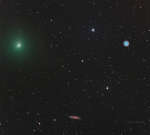 The Comet, the Owl, and the Galaxy
24.03.2017
Comet 41P/Tuttle-Giacobini-Kresak poses for a Messier moment in this telescopic snapshot from March 21. In fact it shares the 1 degree wide field-of-view with two well-known entries in the 18th century comet-hunting astronomer's famous catalog.
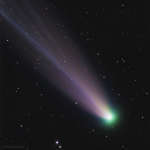 Comet Leonard Closeup from Australia
12.01.2022
What does Comet Leonard look like up close? Although we can't go there, imaging the comet's coma and inner tails through a small telescope gives us a good idea. As the name...
 Charon: Moon of Pluto
3.06.2023
A darkened and mysterious north polar region known to some as Mordor Macula caps this premier high-resolution view. The portrait of Charon, Pluto's largest moon, was captured by New Horizons near the spacecraft's closest approach on July 14, 2015.
 Galileo s Europa
29.03.2024
Looping through the Jovian system in the late 1990s, the Galileo spacecraft recorded stunning views of Europa and uncovered evidence that the moon's icy surface likely hides a deep, global ocean. Galileo...
 APOD: 2025 June 27 Б Messier 109
27.06.2025
Big beautiful barred spiral galaxy Messier 109 is the 109th entry in Charles Messier's famous catalog of bright Nebulae and Star Clusters. You can find it just below the Big Dipper's bowl in the northern constellation Ursa Major.
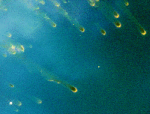 Cometary Knots in the Helix Nebula
16.04.1996
Four hundred fifty light-years from Earth, the wind from a dying, sun-like star produced a planetary nebula popularly known as the Helix. While exploring the Helix's gaseous envelope with the Hubble Space Telescope (HST), astronomers discovered indications of 1,000s of striking "cometary knots" like those shown above.
|
January February March April May June July August September October |
|||||||||||||||||||||||||||||||||||||||||||||||||