
|
You entered: Earth
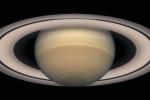 Saturn: Lord of the Rings
17.01.2004
Born in 1564, Galileo used a telescope to explore the Solar System. In 1610, he became the first to be amazed by Saturn's rings, After nearly 400 years, Saturn's magnificent rings still offer one of the most stunning astronomical sights.
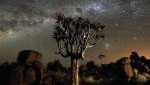 Namibian Nights
4.02.2013
Namibia has some of the darkest nights visible from any continent. It is therefore home to some of the more spectacular skyscapes, a few of which have been captured in the above time-lapse video.
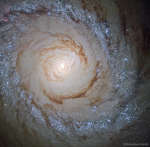 Starburst Galaxy M94 from Hubble
1.12.2019
Why does this galaxy have a ring of bright blue stars? Beautiful island universe Messier 94 lies a mere 15 million light-years distant in the northern constellation of the Hunting Dogs (Canes Venatici).
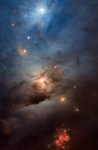 NGC 1333: Stellar Nursery in Perseus
22.04.2023
In visible light NGC 1333 is seen as a reflection nebula, dominated by bluish hues characteristic of starlight reflected by interstellar dust. A mere 1,000 light-years distant toward the heroic constellation Perseus, it lies at the edge of a large, star-forming molecular cloud.
 Magnetar
27.05.1998
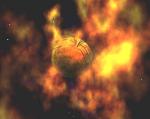
What do you call a neutron star with a super-strong magnetic field? You guessed it ... a Magnetar. Imagine a star with more mass than the sun, the density of a neutron, and a magnetic field about a thousand trillion (a one followed by 15 zeroes) times stronger than Earth's.
 EHT Resolves Central Jet from Black Hole in Cen A
4.08.2021
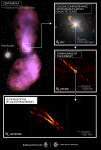
How do supermassive black holes create powerful jets? To help find out, the Event Horizon Telescope (EHT) imaged the center of the nearby active galaxy Centaurus A. The cascade of featured inset images shows...
 A Cosmic Zoo in Cepheus
17.08.2023
Sprawling emission nebulae IC 1396 and Sh2-129 mix glowing interstellar gas and dark dust clouds in this nearly 12 degree wide field of view toward the northern constellation Cepheus the King. Energized by its central star IC 1396 (left), is hundreds of light-years across and some 3,000 light-years distant.
 Solar System Family Portrait
13.07.2024
In 1990, cruising four billion miles from the Sun, the Voyager 1 spacecraft looked back to make this first ever Solar System family portrait. The complete portrait is a 60 frame mosaic made from a vantage point 32 degrees above the ecliptic plane.
 Globular Star Cluster NGC 6752
25.10.2024
Some 13,000 light-years away toward the southern constellation Pavo, the globular star cluster NGC 6752 roams the halo of our Milky Way galaxy. Over 10 billion years old, NGC 6752 follows clusters Omega Centauri, 47 Tucanae, and Messier 22 as the fourth brightest globular in planet Earth's night sky.
 Balloon TIGER
1.02.2002
Where does a two-ton tiger hang out? Well, in this case the Trans-Iron Galactic Element Recorder (TIGER) experiment hangs from a mobile crane on the far left in this panorama photo recorded last December near McMurdo Station, Antarctica.
|
January February March April May June July August September October |
|||||||||||||||||||||||||||||||||||||||||||||||||