
|
You entered: distance
 The Falcon and the Redstone
3.08.2023
In a photo from the early hours of July 29 (UTC), a Redstone rocket and Mercury capsule are on display at Cape Canaveral Launch Complex 5. Beyond the Redstone, the 8 minute long exposure has captured the arcing launch streak of a SpaceX Falcon Heavy rocket.
 APOD: 2025 July 7 Б Interstellar Comet 3I ATLAS
7.07.2025
It came from outer space. An object from outside our Solar System is now passing through at high speed. Classified as a comet because of its gaseous coma, 3I/ATLAS is only the third identified macroscopic object as being so alien.
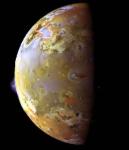 Io: The Prometheus Plume
22.06.2002
Two sulfurous eruptions are visible on Jupiter's volcanic moon Io in this color composite Galileo image. On the left, over Io's limb, a new bluish plume rises about 86 miles above the surface of a volcanic caldera known as Pillan Patera.
 Missoula Crater on Mars
4.05.2004
Scroll right to see the rocks, craters, and hills that were in view for the Spirit rover last week as it continued its trek across Mars. Missoula crater, taking up much of the above frame, appeared from orbit to have ejecta from Bonneville crater inside it.
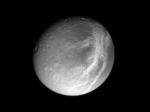 Saturns Moon Dione from Cassini
1.12.2004
What causes the bright streaks on Dione? Recent and likely future images of this unusual moon by the robot Cassini spacecraft now orbiting Saturn might help us find out. The above image was taken at the end of October from a distance of about one million kilometers.
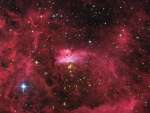 Massive Stars in NGC 6357
9.10.2008
Massive Stars lie within NGC 6357, an expansive emission nebula complex some 8,000 light-years away in the tail of the constellation Scorpius. In fact, positioned just below center in this close-up view...
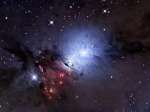 NGC 1333 Stardust
18.04.2009
NGC 1333 is seen in visible light as a reflection nebula, dominated by bluish hues characteristic of starlight reflected by dust. A mere 1,000 light-years distant toward the heroic constellation Perseus, it lies at the edge of a large, star-forming molecular cloud.
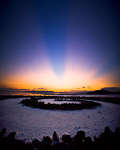 Sunset at the Spiral Jetty
4.12.2010
In dwindling twilight at an August day's end, these broad dark bands appeared in the sky for a moment, seen from Robert Smithson's Spiral Jetty on the eastern shore of Utah's Great Salt Lake.
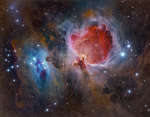 Great Orion Nebulae
13.09.2011
The Great Nebula in Orion, also known as M42, is one of the most famous nebulas in the sky. The star forming region's glowing gas clouds and hot young stars...
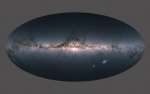 Gaia's Milky Way
27.04.2018
This grand allsky view of our Milky Way and nearby galaxies is not a photograph. It's a map based on individual measurements for nearly 1.7 billion stars. The astronomically rich data set used...
|
January February March April May June July August September October |
|||||||||||||||||||||||||||||||||||||||||||||||||