
|
You entered: distance
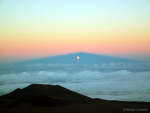 Moonrise Through Mauna Keas Shadow
10.03.2019
How can the Moon rise through a mountain? It cannot -- what was photographed here is a moonrise through the shadow of a large volcano. The volcano is Mauna Kea, Hawai'i, USA, a frequent spot for spectacular photographs since it is one of the premier observing locations on planet Earth.
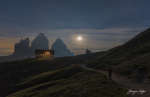 The Moon and Jupiter over the Alps
2.09.2019
What are those bright lights in the sky ahead? When hiking a high mountain pass in northern Italy three weeks ago, a conjunction between our Moon and the distant planet Jupiter was visible as both rose together in the southwest after sunset.
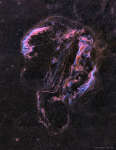 The Ghostly Veil Nebula
31.10.2019
A ghostly visage on a cosmic scale, these remains of shocked, glowing gas haunt planet Earth's sky toward the constellation of Cygnus and form the Veil Nebula. The nebula itself is a large supernova remnant, an expanding cloud born of the death explosion of a massive star.
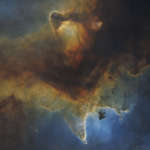 The Central Soul Nebula Without Stars
10.11.2020
This cosmic close-up looks deep inside the Soul Nebula. The dark and brooding dust clouds near the top, outlined by bright ridges of glowing gas, are cataloged as IC 1871. About 25 light-years across, the telescopic field of view spans only a small part of the much larger Heart and Soul nebulae.
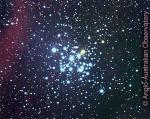 NGC 3293: A Bright Young Open Cluster
9.09.2001
Hot blue stars shine brightly in this beautiful, recently formed galactic or "open" star cluster. Open cluster NGC 3293 is located in the constellation Carina, lies at a distance of about 8000 light years, and has a particularly high abundance of these young bright stars.
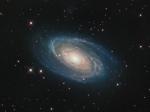 Bright Galaxy M81
7.07.2006
Big and beautiful spiral galaxy M81 lies in the northern constellation Ursa Major. One of the brightest galaxies in planet Earth's sky, M81 is also home to the second brightest supernova seen in modern times.
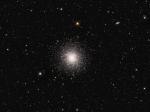 M13: The Great Globular Cluster in Hercules
18.05.2007
In 1714, Edmond Halley noted that M13 "shows itself to the naked eye when the sky is serene and the Moon absent." Of course, M13 is now modestly recognized as the Great Globular Cluster in Hercules, one of the brightest globular star clusters in the northern sky.
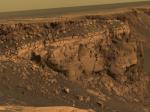 At the Edge of Victoria Crater
3.07.2007
We're going in. The robotic Opportunity rover currently rolling across Mars has been prowling around the edge of the largest crater it has visited since landing over three years ago. It has been studying Victoria crater and looking for a way in.
 NGC 3621: Far Beyond the Local Group
19.09.2009
Far beyond the local group of galaxies lies NGC 3621, some 22 million light-years away. Found in the multi-headed southern constellation Hydra, the winding spiral arms of this gorgeous island universe are loaded with luminous young star clusters and dark dust lanes.
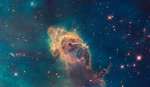 Carina Pillar and Jets
1.10.2009
This cosmic pillar of gas and dust is nearly 2 light-years wide. The structure lies within one of our galaxy's largest star forming regions, the Carina Nebula, shining in southern skies at a distance of about 7,500 light-years.
|
January February March April May June July August September October |
|||||||||||||||||||||||||||||||||||||||||||||||||