
|
You entered: distance
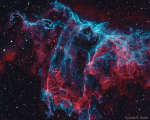 NGC 6995: The Bat Nebula
24.11.2019
Do you see the bat? It haunts this cosmic close-up of the eastern Veil Nebula. The Veil Nebula itself is a large supernova remnant, the expanding debris cloud from the death explosion of a massive star.
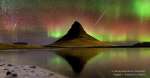 Meteors and Auroras over Iceland
12.12.2021
What's going on behind that mountain? Quite a bit. First of all, the mountain itself, named Kirkjufell, is quite old and located in western Iceland near the town of Grundarfjцrцur. In front...
 Circling the Sun
12.01.2024
Earth's orbit around the Sun is not a circle, it's an ellipse. The point along its elliptical orbit where our fair planet is closest to the Sun is called perihelion. This year...
 APOD: 2024 May 21 Б CG4: The Globule and the Galaxy
20.05.2024
Can a gas cloud eat a galaxy? It's not even close. The "claw" of this odd looking "creature" in the featured photo is a gas cloud known as a cometary globule. This globule, however, has ruptured. Cometary globules are typically characterized by dusty heads and elongated tails.
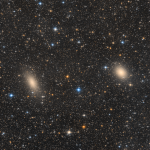 NGC 147 and NGC 185
12.02.2026
Dwarf galaxies NGC 147 (left) and NGC 185 stand side by side in this deep telescopic portrait. The two are not-often-imaged satellite galaxies of M31, the great spiral Andromeda Galaxy, some 2.5 million light-years away.
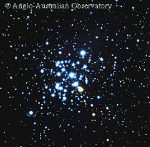 NGC 3293: A Bright Young Open Cluster
23.08.1996
Hot Blue stars shine brightly in this beautiful, recently formed galactic or "open" star cluster. Open cluster NGC 3293 is located in the constellation Carina, lies at a distance of about 8000 light years, and has a particularly high abundance of these young bright stars.
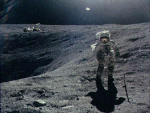 Apollo 16: Exploring Plum Crater
19.12.1997
Apollo 16 spent three days on Earth's Moon in April 1972. The fifth lunar landing mission out of six, Apollo 16 was famous for deploying and using an ultraviolet telescope as the first lunar observatory, and for collecting rocks and data on the mysterious lunar highlands. In the above picture, astronaut John W.
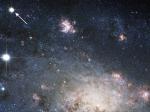 A Supernova in Nearby Galaxy NGC 2403
7.09.2004
The closest and brightest supernova in over a decade was recorded just over a month ago in the outskirts of nearby galaxy NGC 2403. Officially tagged SN 2004dj, the Type IIP explosion likely annihilated most of a blue supergiant star as central fusion could no longer hold it up.
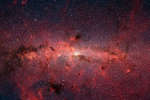 Stars at the Galactic Center
14.06.2009
The center of our Milky Way Galaxy is hidden from the prying eyes of optical telescopes by clouds of obscuring dust and gas. But in this stunning vista, the Spitzer Space Telescope's infrared cameras, penetrate much of the dust revealing the stars of the crowded galactic center region.
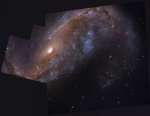 NGC 2442: Galaxy in Volans
24.03.2010
Distorted galaxy NGC 2442 can be found in the southern constellation of the flying fish, (Piscis) Volans. Located about 50 million light-years away, the galaxy's two spiral arms extending from a pronounced central bar have a hook-like appearance in wide-field images.
|
January February March April May June July August September October |
|||||||||||||||||||||||||||||||||||||||||||||||||