
|
You entered: distance
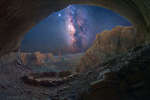 A True Image from False Kiva
29.09.2008
Is there any place in the world you could see a real sight like this? Yes. Pictured above is single exposure image spectacular near, far, and in between. Diving into the Earth far in the distance is part of the central band of our Milky Way Galaxy, taken with a long duration exposure.
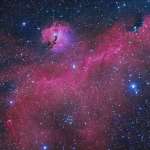 The Seagull Nebula
12.01.2011
This broad expanse of glowing gas and dust presents a bird-like visage to astronomers from planet Earth, suggesting its popular moniker - The Seagull Nebula. This portrait of the cosmic bird covers a 1.6 degree wide swath across the plane of the Milky Way, near the direction of Sirius, alpha star of the constellation Canis Major.
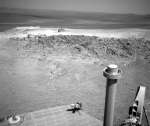 Opportunity Rover Spots Greeley Haven on Mars
25.01.2012
Where on Mars should you spend the winter? As winter approached in the southern hemisphere of Mars last November, the Opportunity rover had just this problem -- it needed a place to go. The reduced...
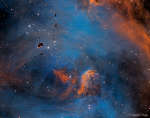 Stars and Globules in the Running Chicken Nebula
20.01.2016
The eggs from this gigantic chicken may form into stars. The featured emission nebula, shown in scientifically assigned colors, is cataloged as IC 2944 but known as the Running Chicken Nebula for the shape of its greater appearance. Seen toward the top of the image are small, dark molecular clouds rich in obscuring cosmic dust.
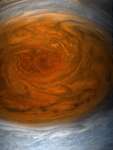 Close up of the Great Red Spot
15.07.2017
On July 11, the Juno spacecraft once again swung near to Jupiter's turbulent cloud tops in its looping 53 day orbit around the Solar System's ruling gas giant. About 11 minutes after perijove 7, its closest approach on this orbit, it passed directly above Jupiter's Great Red Spot.
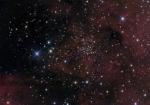 Tombaugh 4
21.10.2006
Clyde Tombaugh discovered planet Pluto in 1930 while surveying the skies with the 13-inch Lawrence Lowell Telescope. But the skilled and careful astronomer also went on to discover star clusters, comets, asteroids, and clusters of galaxies. For example, pictured is galactic or open star cluster Tombaugh 4 in the northern constellation Cassiopeia.
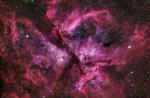 The Great Carina Nebula
27.10.2007
A jewel of the southern sky, the Great Carina Nebula, aka NGC 3372, spans over 300 light-years, one of our galaxy's largest star forming regions. Like the smaller, more northerly Orion Nebula...
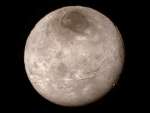 Charon
17.07.2015
Icy world Charon is 1,200 kilometers across. That makes Pluto's largest moon only about 1/10th the size of planet Earth but a whopping 1/2 the diameter of Pluto itself. Charon is seen in unprecedented detail in this image from New Horizons.
 Comet PanSTARRS, Moon, and Venus
23.07.2015
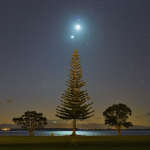
It is the object to the left of the big tree that's generating much recent excitement. If you look closely, there you can see Comet PanSTARRS, complete with two tails. During July, this comet has increased markedly in brightness and has just passed its closest approach to Earth.
 The Seagull Nebula
29.08.2015
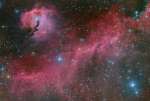
A broad expanse of glowing gas and dust presents a bird-like visage to astronomers from planet Earth, suggesting its popular moniker - The Seagull Nebula. This portrait of the cosmic bird covers a 1.6 degree wide swath across the plane of the Milky Way, near the direction of Sirius, alpha star of the constellation Canis Major.
|
January February March April May June July August September October |
|||||||||||||||||||||||||||||||||||||||||||||||||