
|
You entered: phase
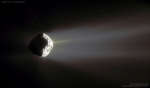 Comet Churyumov Gerasimenko in Crescent
29.04.2015
What's happening to Comet 67P/ChuryumovGerasimenko? As the 3-km wide comet moves closer to the Sun, heat causes the nucleus to expel gas and dust. The Rosetta spacecraft arrived at the comet's craggily double nucleus last July and now is co-orbiting the Sun with the giant dark iceberg.
 APOD: 2023 October 3 Б MyCn 18: The Engraved Hourglass Planetary Nebula
3.10.2023
Do you see the hourglass shape -- or does it see you? If you can picture it, the rings of MyCn 18 trace the outline of an hourglass -- although one with an unusual eye in its center. Either way, the sands of time are running out for the central star of this hourglass-shaped planetary nebula.
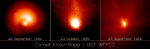 Comet Hale-Bopp Inbound
19.12.1996
Headed toward the inner Solar System, the much anticipated Comet Hale-Bopp has promised to put on a big show next spring. The comet's apparent brightness is currently approaching 4th magnitude and its inbound journey has been closely followed by many observers.
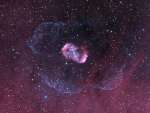 A Halo for NGC 6164
27.10.2012
Beautiful emission nebula NGC 6164 was created by a rare, hot, luminous O-type star, some 40 times as massive as the Sun. Seen at the center of the cosmic cloud, the star is a mere 3 to 4 million years old.
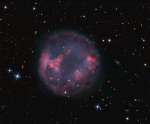 Planetary Nebula Abell 7
5.12.2013
Very faint planetary nebula Abell 7 is some 1,800 light-years distant, just south of Orion in planet Earth's skies in the constellation Lepus, The Hare. Surrounded by Milky Way stars and near...
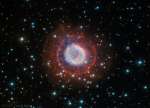 Planetary Nebula NGC 2438
7.04.2011
NGC 2438 is a planetary nebula, the gaseous shroud cast off by a dying sunlike star billions of years old whose central reservoir of hydrogen fuel has been exhausted. About 3,000 light-years distant it lies within the boundaries of the nautical constellation Puppis.
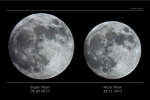 Super Moon vs Micro Moon
13.11.2016
What is so super about tomorrow's supermoon? Tomorrow, a full moon will occur that appears slightly larger and brighter than usual. The reason is that the Moon's fully illuminated phase occurs within a short time from perigee - when the Moon is its closest to the Earth in its elliptical orbit.
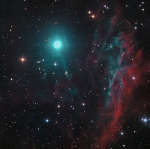 The Ghost of Jupiter s Halo
11.07.2019
Close-up images of NGC 3242 show the cast off shroud of a dying, sun-like star fancifully known as The Ghost of Jupiter nebula. But this deep and wide telescopic view also finds the seldom...
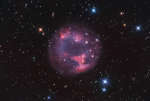 Planetary Nebula Abell 7
21.05.2022
Very faint planetary nebula Abell 7 is some 1,800 light-years distant, just south of Orion in planet Earth's skies in the constellation Lepus, The Hare. Surrounded by Milky Way stars and near...
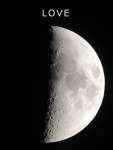 Lunar LOVE
3.11.2018
A more creative search by a group of amateur astronomers in the Ehime Prefecture of Shikoku Island, Japan has found lunar L-O-V-E. Their secret was an examination of this sharp image of the First Quarter Moon.
|
January February March April May June July August |
||||||||||||||||||||||||||||||||||||||||||||||||||||||||