
|
You entered: phase
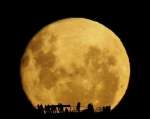 Full Moon Silhouettes
7.09.2014
Have you ever watched the Moon rise? The slow rise of a nearly full moon over a clear horizon can be an impressive sight. One impressive moonrise was imaged in early 2013 over Mount Victoria Lookout in Wellington, New Zealand.
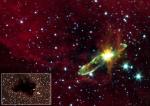 Young Star, Dark Cloud
26.12.2003
High-speed outflows of molecular gas from a young stellar object glow in infrared light, revealing themselves in this recent false-color image from the Spitzer Space Telescope. Cataloged as HH (Herbig-Haro) 46/47 the infrared source...
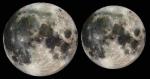 Perigee Moon, Apogee Moon
22.12.1999
Tonight, those blessed with clear skies can enjoy a glorious full moon, the last full moon of the "Y1.9K"s. In fact, tonight's moon will be a full-perigee-solstice moon, reaching its full phase and perigee (the closest point in its orbit) on the solstice, the first day of northern hemisphere winter.
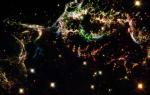 Recycling Cassiopeia A
12.07.2002
For billions of years, massive stars in our Milky Way Galaxy have lived spectacular lives. Collapsing from vast cosmic clouds, their nuclear furnaces ignite and create heavy elements in their cores. After a few million years, the enriched material is blasted back into interstellar space where star formation begins anew.
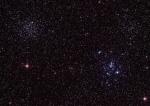 Stars Young and Old
4.08.2005
Galactic or open star clusters are relatively young swarms of bright stars born together near the plane of our Milky Way Galaxy. Separated by about a degree on the sky, two nice examples...
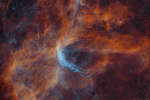 APOD: 2026 May 22 Б The Nebulous Realm of WR 134
22.05.2026
This cosmic snapshot covers a field of view over twice as wide as the full Moon within the boundaries of the high-flying constellation Cygnus. Made using astronomical narrowband filters, the image highlights the bright edge of a ring-like nebula traced by the glow of ionized hydrogen and oxygen gas.
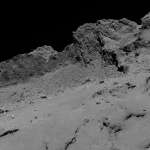 Rosetta s Farewell
1.10.2016
After closely following comet 67P/Churyumov-Gerasimenko for 786 days as it rounded the Sun, the Rosetta spacecraft's controlled impact with the comet's surface was confirmed by the loss of signal from the spacecraft on September 30, 2016.
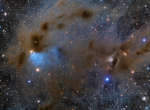 Young Stars and Dusty Nebulae in Taurus
30.03.2017
This complex of dusty nebulae lingers along the edge of the Taurus molecular cloud, a mere 450 light-years distant. Stars are forming on the cosmic scene. Composed from almost 40 hours of image data...
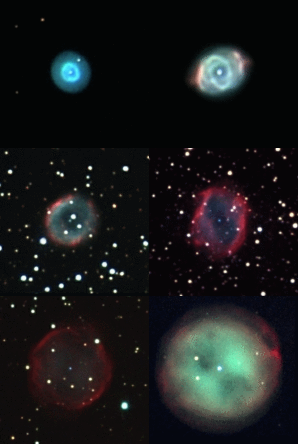 The Planetary Nebula Show
14.06.2003
What do the Owl, the Cat's Eye, the Ghost of Jupiter, and Saturn have in common? They're all planetary nebulae of course, glowing gaseous shrouds shed by dying sun-like stars as they run out of nuclear fuel.
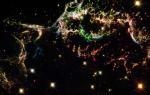 Recycling Cassiopeia A
30.08.2003
For billions of years, massive stars in our Milky Way Galaxy have lived spectacular lives. Collapsing from vast cosmic clouds, their nuclear furnaces ignite and create heavy elements in their cores. After a few million years, the enriched material is blasted back into interstellar space where star formation begins anew.
|
January February March April May June July August |
||||||||||||||||||||||||||||||||||||||||||||||||||||||||