
|
You entered: phase
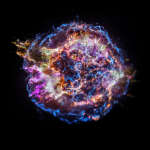 Recycling Cassiopeia A
27.12.2017
Massive stars in our Milky Way Galaxy live spectacular lives. Collapsing from vast cosmic clouds, their nuclear furnaces ignite and create heavy elements in their cores. After a few million years, the enriched material is blasted back into interstellar space where star formation can begin anew.
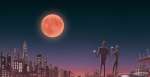 Tonight: A Supermoon Lunar Eclipse
26.09.2015
Tonight a bright full Moon will fade to red. Tonight's moon will be particularly bright because it is reaching its fully lit phase when it is relatively close to the Earth in its elliptical orbit.
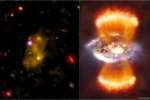 Lyman Alpha Blob
2.07.2009
Dubbed a Lyman-alpha blob, an enormous cloud of hydrogen gas spans several hundred thousand light-years in this remarkable image (left), a composite of x-ray, optical, and infrared data from space and ground based observatories.
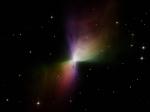 The Boomerang Nebula in Polarized Light
14.09.2005
Why did the Boomerang Nebula form? The symmetric cloud dubbed the Boomerang appears to have been created by a high-speed wind of gas and dust blowing from an aging central star at speeds of nearly 600,000 kilometers per hour.
 A Rare Hybrid Solar Eclipse
3.11.2013
A spectacular geocentric celestial event of 2005 was a rare hybrid eclipse of the Sun - a total or an annular eclipse could be seen depending on the observer's location. For Fred Espenak, aboard...
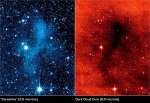 Coreshine from a Dark Cloud
30.09.2010
Stars and their planets are born in cold, dark, interstellar clouds of gas and dust. While exploring the clouds at infrared wavelengths, astronomers have made a surprising discovery -- dozens of cases where dense cloud cores shine by reflecting infrared starlight.
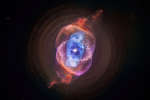 X Rays from the Cats Eye Nebula
4.08.2008
Haunting patterns within planetary nebula NGC 6543 readily suggest its popular moniker -- the Cat's Eye nebula. Starting in 1995, stunning false-color optical images from the Hubble Space Telescope detailed the swirls of this glowing nebula, known to be the gaseous shroud expelled from a dying sun-like star about 3,000 light-years from Earth.
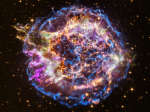 Recycling Cassiopeia A
5.09.2019
Massive stars in our Milky Way Galaxy live spectacular lives. Collapsing from vast cosmic clouds, their nuclear furnaces ignite and create heavy elements in their cores. After a few million years, the enriched material is blasted back into interstellar space where star formation can begin anew.
 Recycling Cassiopeia A
22.01.2021
Massive stars in our Milky Way Galaxy live spectacular lives. Collapsing from vast cosmic clouds, their nuclear furnaces ignite and create heavy elements in their cores. After a few million years, the enriched material is blasted back into interstellar space where star formation can begin anew.
 Recycling Cassiopeia A
31.05.2023
Massive stars in our Milky Way Galaxy live spectacular lives. Collapsing from vast cosmic clouds, their nuclear furnaces ignite and create heavy elements in their cores. After a few million years, the enriched material is blasted back into interstellar space where star formation can begin anew.
|
January February March April May June July August |
||||||||||||||||||||||||||||||||||||||||||||||||||||||||