
|
You entered: space
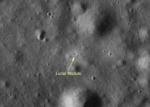 Lunar Module at Taurus Littrow
28.06.2002
Can the Hubble Space Telescope take a picture that shows the Apollo lunar modules on the Moon? With its 2.4 meter diameter mirror, the smallest object that the Hubble can resolve at the Moon's distance of around 400,000 kilometers is about 80 meters across.
 A Chicago Meteorite Fall
24.07.2005
If you wait long enough, a piece of outer space itself will come right to you. As Colby Navarro worked innocently on the computer, a rock from space crashed through the roof, struck the printer, banged off the wall, and came to rest near the filing cabinet.
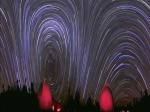 Warped Sky: Star Trails Panorama
13.06.2007
What's happened to the sky? A time warp, of sorts, and a digital space warp too. The time warp occurs because the above image captured in a single frame a four hour exposure of the night sky. Prominent and picturesque star trails are visible.
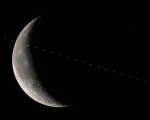 Trifecta at Twilight
20.02.2020
On February 18, as civil twilight began in northern New Mexico skies, the International Space Station, a waning crescent Moon, and planet Mars for a moment shared this well-planned single field of view. From...
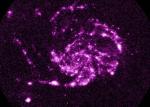 M101: An Ultraviolet View
8.06.1997
This giant spiral galaxy, Messier 101 (M101), was photographed by the Ultraviolet Imaging Telescope (UIT). UIT flew into orbit as part of the Astro 2 mission on-board the Space Shuttle Endeavour in March 1995. The image has been processed so that the colors (purple to white) represent an increasing intensity of ultraviolet light.
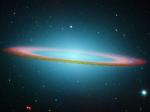 The Sombrero Galaxy in Infrared
21.01.2007
This floating ring is the size of a galaxy. In fact, it is part of the photogenic Sombrero Galaxy, one of the largest galaxies in the nearby Virgo Cluster of Galaxies. The dark band of dust that obscures the mid-section of the Sombrero Galaxy in optical light actually glows brightly in infrared light.
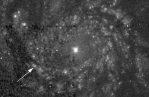 A Supernova in the Whirlpool
21.04.1996
In 1994, a new star in a distant galaxy was seen by amateur astronomers, who alerted the world to their discovery of a supernova. Near the nucleus of spiral galaxy M51, popularly known...
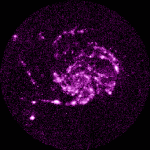 An Ultraviolet Image of M101
27.06.1995
This giant spiral galaxy, Messier 101 (M101), was photographed by the Ultraviolet Imaging Telescope onboard the Space Shuttle Endeavour during the Astro-2 mission (March 2 - 18, 1995). The image has been computer processed so that the colors represent the intensity of ultraviolet light.
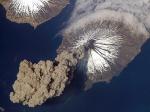 An Alaskan Volcano Erupts
7.06.2006
What is happening to that volcano? It's erupting! The first person to note that the Aleutian Cleveland Volcano was spewing ash was astronaut Jeffrey N. Williams aboard the International Space Station. Looking down...
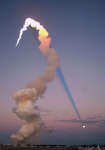 Shuttle Plume Shadow Points to the Moon
27.11.2011
Why would the shadow of a space shuttle launch plume point toward the Moon? In early 2001 during a launch of Atlantis, the Sun, Earth, Moon, and rocket were all properly aligned for this photogenic coincidence.
|
January February March April May June July August September October |
|||||||||||||||||||||||||||||||||||||||||||||||||