
|
You entered: space
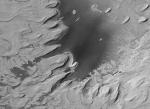 Ancient Layered Rocks on Mars
26.11.2001
Is this a picture of Mars or Earth? Oddly enough, it is a picture of Mars. What may appear to some as a terrestrial coastline is in fact a formation of ancient layered rocks and wind-blown sand on Mars. The above-pictured region spans about three kilometers in Schiaparelli Crater.
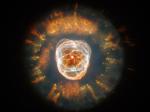 The Eskimo Nebula from Hubble
9.07.2006
In 1787, astronomer William Herschel discovered the Eskimo Nebula. From the ground, NGC 2392 resembles a person's head surrounded by a parka hood. In 2000, the Hubble Space Telescope imaged the Eskimo Nebula. From space, the nebula displays gas clouds so complex they are not fully understood.
 Rocket Engine Fireplace
6.12.2024
You might not think a close up view of rocket engines producing 8.8 million pounds of thrust would be relaxing, but here it can be. In fact, you can get a warm and cozy feeling just spending a few moments watching NASA's holiday rocket engine fireplace.
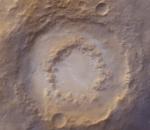 A Frosty Crater On Mars
30.11.2000
In the martian southern hemisphere, autumn has arrived. As on planet Earth, the cooler temperatures bring a seasonal frost to the landscape. Of course on Mars, the surface temperatures can be really cool, reaching below minus 100 degrees C.
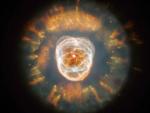 The Eskimo Nebula from Hubble
7.04.2002
In 1787, astronomer William Herschel discovered the Eskimo Nebula. From the ground, NGC 2392 resembles a person's head surrounded by a parka hood. In 2000, the Hubble Space Telescope imaged the Eskimo Nebula. From space, the nebula displays gas clouds so complex they are not fully understood.
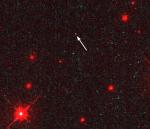 A Lonely Neutron Star
26.09.1997
How massive can a star get without imploding into a black hole? These limits are being tested by the discovery of a lone neutron star in space. Observations by the Hubble Space Telescope released...
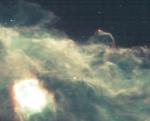 Infrared Horsehead
6.08.1998
This famous cosmic dust cloud was imaged in infrared light by the European Space Agency's Infrared Space Observatory (ISO) satellite. The false-color picture shows the bright infrared emission from dust and molecular gas in part of the Orion star forming region surrounding the Horsehead Nebula.
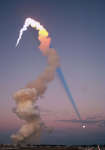 Rocket Plume Shadow Points to the Moon
23.06.2018
Why would the shadow of a space shuttle launch plume point toward the Moon? In early 2001 during a launch of Atlantis, the Sun, Earth, Moon, and rocket were all properly aligned for this photogenic coincidence.
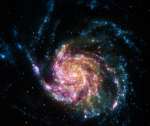 21st Century M101
13.07.2012
One of the last entries in Charles Messier's famous catalog, big, beautiful spiral galaxy M101 is definitely not one of the least. About 170,000 light-years across, this galaxy is enormous, almost twice the size of our own Milky Way Galaxy.
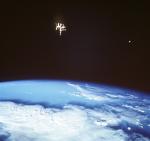 The Moons of Earth
4.05.2002
While orbiting the planet during their June 1998 mission, the crew of the Space Shuttle Discovery photographed this view of two moons of Earth. Thick storm clouds are visible in the lovely blue planet...
|
January February March April May June July August September October |
|||||||||||||||||||||||||||||||||||||||||||||||||