
|
You entered: ultraviolet
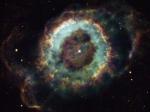 NGC 6369: The Little Ghost Nebula
7.02.2004
This pretty planetary nebula, cataloged as NGC 6369, was discovered by 18th century astronomer William Herschel as he used a telescope to explore the medicinal constellation Ophiucus. Round and planet-shaped, the nebula is also relatively faint and has acquired the popular moniker of Little Ghost Nebula.
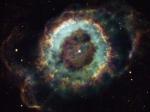 NGC 6369: The Little Ghost Nebula
8.11.2002
This pretty planetary nebula, cataloged as NGC 6369, was discovered by 18th century astronomer William Herschel as he used a telescope to explore the constellation Ophiucus. Round and planet-shaped, the nebula is also relatively faint and has acquired the popular moniker of Little Ghost Nebula.
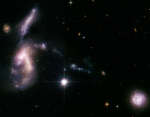 Galaxy Group Hickson 31
22.02.2010
Will the result of these galactic collisions be one big elliptical galaxy? Quite possibly, but not for another billion years. Pictured above, several of the dwarf galaxies of in the Hickson Compact Group 31 are seen slowly merging.
 The W in Cassiopeia
18.03.2016
A familiar, zigzag, W pattern in northern constellation Cassiopeia is traced by five bright stars in this colorful and broad mosaic. Stretching about 15 degrees across rich starfields, the celestial scene includes dark clouds, bright nebulae, and star clusters along the Milky Way. In yellow-orange hues Cassiopeia's alpha star Shedar is a standout though.
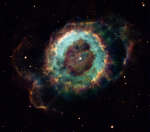 NGC 6369: The Little Ghost Nebula
28.10.2017
Wraithlike NGC 6369 is a faint apparition in night skies popularly known as the Little Ghost Nebula. It was discovered by 18th century astronomer Sir William Herschel as he used a telescope to explore the medicinal constellation Ophiucus. Herschel historically classified the round and planet-shaped nebula as a Planetary Nebula.
 APOD: 2025 June 3 Б Rainbow Airglow over the Azores
3.06.2025
Why would the sky glow like a giant repeating rainbow? Airglow. Now, air glows all of the time, but it is usually hard to see. A disturbance however -- like an approaching storm -- may cause noticeable rippling in the Earth's atmosphere.
 The Colors of Comet Hyakutake
29.03.1996
The colors of Comet Hyakutake are caused by the action of sunlight on the dust and gas produced by the warming nucleus. The microscopic dust particles reflect sunlight while the sun's ultraviolet radiation excites and ionizes the gas molecules causing them to glow or fluoresce in a range of visible colors.
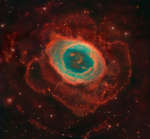 M57: The Ring Nebula
20.04.2012
Except for the rings of Saturn, the Ring Nebula (M57) is probably the most famous celestial band. Its classic appearance is understood to be due to perspective - our view from planet Earth looks down the center of a roughly barrel-shaped cloud of glowing gas.
 The Hydrogen Clouds of M33
30.09.2021
Gorgeous spiral galaxy M33 seems to have more than its fair share of glowing hydrogen gas. A prominent member of the local group of galaxies, M33 is also known as the Triangulum Galaxy and lies a mere 3 million light-years away.
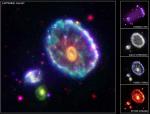 Cartwheel Of Fortune
18.01.2006
By chance, a collision of two galaxies has created a surprisingly recognizable shape on a cosmic scale - The Cartwheel Galaxy. The Cartwheel is part of a group of galaxies about 400 million light years away in the constellation Sculptor (two smaller galaxies in the group are visible below and left).
|
January February March April May June July August September October |
|||||||||||||||||||||||||||||||||||||||||||||||||