
|
You entered: ultraviolet
 Across the Universe
28.03.2008
How far can you see? Even the faintest stars visible to the eye are merely hundreds or thousands of light-years distant, all well within our own Milky Way Galaxy. Of course, if you know where to look you can also spot the Andromeda Galaxy as a pale, fuzzy cloud, around 2.5 million light-years away.
 NGC 6188: Dragons of Ara
7.06.2022
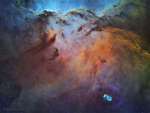
Do dragons fight on the altar of the sky? Although it might appear that way, these dragons are illusions made of thin gas and dust. The emission nebula NGC 6188, home to the glowing...
 NGC 6188 and NGC 6164
30.03.2016
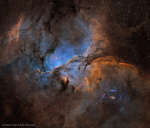
Fantastic shapes lurk in clouds of glowing gas in the giant star forming region NGC 6188. The emission nebula is found about 4,000 light years away near the edge of a large molecular cloud unseen at visible wavelengths, in the southern constellation Ara.
 NGC 3603: From Beginning To End
4.06.1999
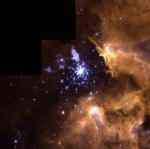
From beginning to end, different stages of a star's life appear in this exciting Hubble Space Telescope picture of the environs of galactic emission nebula NGC 3603. For the beginning, eye-catching "pillars" of glowing hydrogen at the right signal newborn stars emerging from their dense, gaseous, nurseries.
 Lyman Alpha Blob
2.07.2009
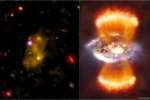
Dubbed a Lyman-alpha blob, an enormous cloud of hydrogen gas spans several hundred thousand light-years in this remarkable image (left), a composite of x-ray, optical, and infrared data from space and ground based observatories.
 M57: The Ring Nebula
5.06.2013
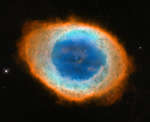
Except for the rings of Saturn, the Ring Nebula (M57) is probably the most famous celestial band. Its classic appearance is understood to be due to our own perspective, though. The recent mapping...
 Layers of a Total Solar Eclipse
27.09.2017
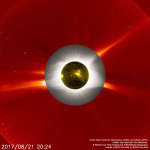
Neither rain, nor snow, nor dark of night can keep a space-based spacecraft from watching the Sun. In fact, from its vantage point 1.5 million kilometers sunward of planet Earth, NASA's SOlar Heliospheric Observatory (SOHO) can always monitor the Sun's outer atmosphere, or corona.
 APOD: 2024 February 20 Б AM1054: Stars Form as Galaxies Collide
20.02.2024
When galaxies collide, how many stars are born? For AM1054-325, featured here in a recently released image by the Hubble Space Telescope, the answer is millions. Instead of stars being destroyed as galaxy AM1054-325 and a nearby galaxy circle each other, their gravity and motion has ignited stellar creation.
 Active Region 1002 on an Unusually Quiet Sun
24.09.2008
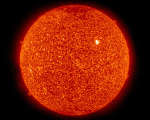
Why has the Sun been so quiet recently? No one is sure. Our Sun has shown few active regions -- that house even fewer associated sunspots -- for over a year now, and such a period of relative calm is quite unusual.
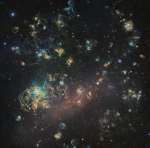 Clouds of the Large Magellanic Cloud
3.05.2019
The Large Magellanic Cloud (LMC) is an alluring sight in southern skies. But this deep and detailed telescopic view, over 10 months in the making, goes beyond what is visible to most circumnavigators of planet Earth.
|
January February March April May June July August September October |
|||||||||||||||||||||||||||||||||||||||||||||||||