
|
You entered: star
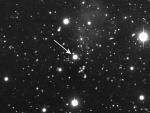 QSO H1821 643 Indicates a Universe Filled with Hydrogen
16.05.2000
A quasar slightly depleted of a specific color of light may indicate that our universe is filled with massive amounts of ionized hydrogen. Light from QSO H1821+643, pictured above, comes to us from about a quarter of the way across the visible universe.
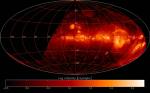 The Southern Sky in Warm Hydrogen
29.01.2002
A robotic telescope with red sunglasses in Chile has been photographing the entire southern sky for years. The result, shown above, is the most complete sky map of the most common visible light emitted from the most abundant element in our Galaxy: hydrogen. A very specific red color emitted by warm ionized hydrogen was observed.
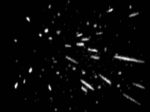 Quadrantids: Meteors in Perspective
26.01.1996
Meteor showers are caused by streams of solid particles, dust size and larger, moving as a group through space. In many cases, the orbits of these meteor streams can be identified with the dust tails of comets.
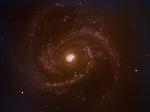 A Nearby Supernova in Spiral Galaxy M100
7.03.2006
One of the nearer supernovas of recent years was discovered last month in the bright nearby galaxy M100. The supernova, dubbed SN 2006X, is still near its maximum brightness and visible with a telescope...
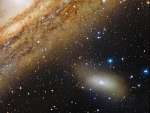 M110: Satellite of the Andromeda Galaxy
9.09.2008
Our Milky Way Galaxy is not alone. It is part of a gathering of about 25 galaxies known as the Local Group. Members include the Great Andromeda Galaxy (M31), M32, M33, the Large Magellanic Cloud, the Small Magellanic Cloud, Dwingeloo 1, several small irregular galaxies, and many dwarf elliptical and dwarf spheroidal galaxies.
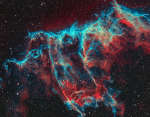 A Spectre in the Eastern Veil
1.11.2008
Menacing flying forms and garish colors are a mark of the Halloween season. They also stand out in this cosmic close-up of the eastern Veil Nebula. The Veil Nebula itself is a large supernova remnant, the expanding debris cloud from the death explosion of a massive star.
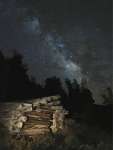 Lyrid Meteor and Milky Way
1.05.2009
On April 22nd, the Lyrid Meteor Shower visited planet Earth's sky, an annual shower produced as the Earth plows through dust from the tail of comet Thatcher. Usually Lyrid meteor watchers see only a drizzle.
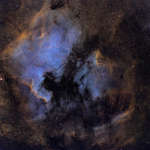 North America and the Pelican
18.12.2010
Here lie familiar shapes in unfamiliar locations. On the left is an emission nebula cataloged as NGC 7000, famous partly because it resembles our fair planet's continent of North America. The emission region to the right of the North America Nebula is IC 5070, also known for its suggestive outlines as the Pelican Nebula.
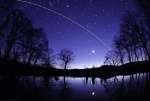 Discovery in Twilight
10.03.2011
As evening twilight faded on March 7, sky gazers around planet Earth enjoyed a beautiful pairing of young crescent Moon and brilliant planet Jupiter. Along with stars setting in the west, the two bright...
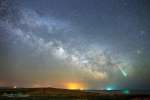 Meteor in the Milky Way
23.04.2015
Earth's April showers include the Lyrid Meteor Shower, observed for more than 2,000 years when the planet makes its annual passage through the dust stream of long-period Comet Thatcher. A grain...
|
January February March April May June July August September October |
|||||||||||||||||||||||||||||||||||||||||||||||||