
|
You entered: star
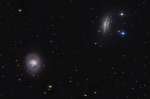 Cetus Duo M77 and NGC 1055
25.12.2014
At the top right, large spiral galaxy NGC 1055 joins spiral Messier 77 in this sharp cosmic view toward the aquatic constellation Cetus. The narrowed, dusty appearance of edge-on spiral NGC 1055 contrasts nicely with the face-on view of M77's bright nucleus and spiral arms.
 APOD: 2024 December 31 Б The Twisted Disk of NGC 4753
31.12.2024
What do you think this is? HereБs a clue: it's bigger than a bread box. Much bigger. The answer is that pictured NGC 4753 is a twisted disk galaxy, where unusual dark dust filaments provide clues about its history.
 APOD: 2025 July 5 Б Ou4: The Giant Squid Nebula
5.07.2025
Difficult to capture, this mysterious, squid-shaped interstellar cloud spans nearly three full moons in planet Earth's sky. Discovered in 2011 by French astro-imager Nicolas Outters, the Squid Nebula's bipolar shape is distinguished here by the telltale blue emission from doubly ionized oxygen atoms.
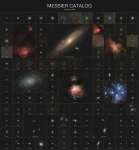 APOD: 2026 May 14 Б The Messier Catalog at Uniform Scale
14.05.2026
What are some of the most interesting astronomical objects you can see in the night sky? Armed with a good pair of binoculars or a small telescope, if you live in the Northern Hemisphere, you can look for the very popular objects in the Messier Catalog.
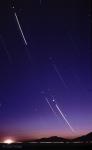 Trailing Planets
10.05.2002
Positioning his camera and tripod on planet Earth, near Maricopa, Arizona, USA, astrophotographer Joe Orman created this trailing display of the ongoing sky-full-of-planets on May 3rd. He initially captured the grouping in a 20 second long time exposure recording the positions of the bright planets and stars.
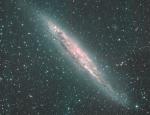 Nearby Spiral Galaxy NGC 4945
21.07.2002
For such a close galaxy, NGC 4945 is easy to miss. NGC 4945 is a spiral galaxy in the Centaurus Group of galaxies, located only six times farther away than the prominent Andromeda Galaxy. The thin disk galaxy is oriented nearly edge-on, however, and shrouded in dark dust.
 Contemplating Mars
2.09.2003
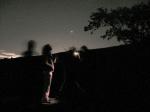
Is that really another world? Thousands of people the world over lined up last week to see Mars through a telescope as the red planet and Earth passed unusually close together in their orbits around the Sun. Reviews of Mars were mixed, with some people disappointed that Mars still appeared somewhat blurry.
 Aurora Oklahoma
13.11.2003
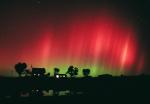
Nestled in the central US, the state of Oklahoma is noted for its gorgeous prairie skies and wide-open spaces, but not for frequent visitations of the northern lights. Still, following the intense solar activity...
 SOFIA s Mirror
22.10.2004
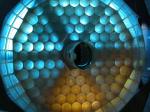
The candy-dish appearance of this high-tech astronomical mirror is striking. Made of a special glass ceramic material called Zerodur, it actually measures 2.7 meters across. The transparent surface has not yet received a reflective...
 Tentacles of the Tarantula Nebula
28.12.2004
The Tarantula Nebula is a giant emission nebula within our neighboring galaxy the Large Magellanic Cloud. Inside this cosmic arachnid lies a huge central young cluster of massive stars, cataloged as R136 and partially visible on the upper right.
|
January February March April May June July August September October |
|||||||||||||||||||||||||||||||||||||||||||||||||