
|
You entered: clouds
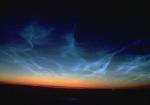 Noctilucent Clouds
15.06.2003
Sometimes it's night on the ground but day in the air. As the Earth rotates to eclipse the Sun, sunset rises up from the ground. Therefore, at sunset on the ground, sunlight still shines on clouds above.
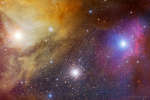 Antares and Clouds
17.04.2012
Antares is a huge star. In a class called red supergiant, Antares is about 850 times the diameter of our own Sun, 15 times more massive, and 10,000 times brighter. Antares is the brightest star in the constellation of Scorpius and one of the brighter stars in all the night sky.
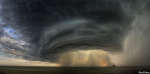 A Supercell Thunderstorm Cloud Over Montana
5.05.2013
Is that a spaceship or a cloud? Although it may seem like an alien mothership, it's actually a impressive thunderstorm cloud called a supercell. Such colossal storm systems center on mesocyclones -- rotating updrafts that can span several kilometers and deliver torrential rain and high winds including tornadoes.
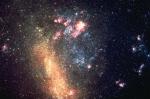 Neighboring Galaxy: The Large Magellanic Cloud
4.08.2001
The brightest galaxy visible from our own Milky Way Galaxy is the Large Magellanic Cloud (LMC). Visible predominantly from Earth's Southern Hemisphere, the LMC is the second closest galaxy, neighbor to the Small Magellanic Cloud, and one of eleven known dwarf galaxies that orbit our Milky Way Galaxy.
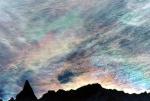 Iridescent Clouds Over Aiguille de la Tsa
14.10.2003
Before the sun rose over the mountains, iridescent colors danced across the sky. The unexpected light show was caused by a batch of iridescent clouds, and captured on film in early September in Arolla, Wallis, Switzerland. The peak in the foreground of the above image is Aiguille de la Tsa.
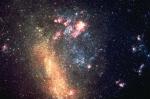 Neighboring Galaxy: The Large Magellanic Cloud
22.02.2000
The brightest galaxy visible from our own Milky Way Galaxy is the Large Magellanic Cloud (LMC). Visible predominantly from Earth's Southern Hemisphere, the LMC is the second closest galaxy, neighbor to the Small Magellanic Cloud, and one of eleven known dwarf galaxies that orbit our Milky Way Galaxy.
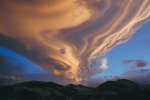 A Lenticular Cloud Over New Zealand
21.01.2009
What's happening above those mountains? Several clouds are stacked up into one striking lenticular cloud. Normally, air moves much more horizontally than it does vertically. Sometimes, however, such as when wind comes off of a mountain or a hill, relatively strong vertical oscillations take place as the air stabilizes.
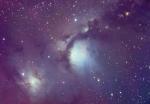 The Reflecting Dust Clouds of Orion
21.01.2003
In the vast Orion Molecular Cloud complex, several bright blue nebula are particularly apparent. Pictured above are two of the most prominent reflection nebulas -- dust clouds lit by the reflecting light of bright-embedded stars. The more famous nebula is M78, on the upper right, cataloged over 200 years ago.
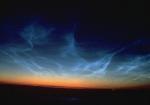 Noctilucent Clouds
19.06.2005
Sometimes it's night on the ground but day in the air. As the Earth rotates to eclipse the Sun, sunset rises up from the ground. Therefore, at sunset on the ground, sunlight still shines on clouds above.
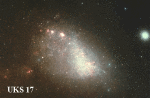 The Small Cloud of Magellan
19.09.1995
Almost unknown to casual observers in the northern hemisphere, the southern sky contains two diffuse wonders known as the Magellanic Clouds. The Magellanic Clouds are small irregular galaxies orbiting our own larger Milky Way spiral galaxy.
|
January February March April May June July August September October |
|||||||||||||||||||||||||||||||||||||||||||||||||