
|
You entered: gravity
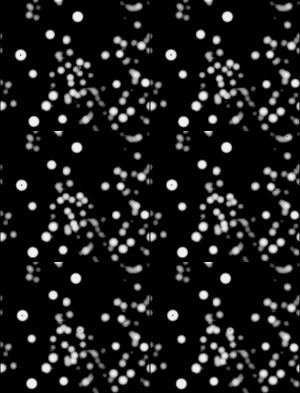 Sgr A*: Fast Stars Near the Galactic Center
14.01.2007
Why are these stars moving so fast? Shown above is a time-lapse movie in infrared light detailing how stars in the central light-year of our Galaxy have moved over the past eight years.
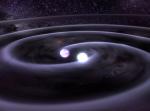 White Dwarf Star Spiral
1.06.2005
About 1,600 light-years away, in a binary star system fondly known as J0806, two dense white dwarf stars orbit each other once every 321 seconds. Interpreting x-ray data from the Chandra Observatory astronomers argue that the stars' already impressively short orbital period is steadily getting shorter as the stars spiral closer together.
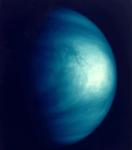 Venus: Just Passing By
12.06.1999
Venus, the second closest planet to the Sun, is a popular way-point for spacecraft headed for the gas giant planets in the outer reaches of the solar system. Why visit Venus first? Using...
 APOD: 2025 November 2 Б A Horseshoe Einstein Ring from Hubble
2.11.2025
What's large and blue and can wrap itself around an entire galaxy? A gravitational lens mirage. Pictured here, the gravity of a massive elliptical galaxy (luminous red galaxy: LRG) has gravitationally distorted the light from a much more distant blue galaxy.
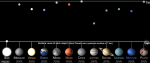 Solar System Ball Drop
25.08.2021
Does a ball drop faster on Earth, Jupiter, or Uranus? The featured animation shows a ball dropping from one kilometer high toward the surfaces of famous solar system bodies, assuming no air resistance. The force of gravity depends on the mass of the attracting object, with higher masses pulling down with greater forces.
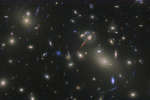 Abell 2218: A Galaxy Cluster Lens
20.06.2010
What are those strange filaments? Background galaxies. Gravity can bend light, allowing huge clusters of galaxies to act as telescopes, and distorting images of background galaxies into elongated strands. Almost all of the bright objects in this Hubble Space Telescope image are galaxies in the cluster known as Abell 2218.
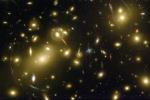 Abell 2218: A Galaxy Cluster Lens
7.10.2001
Gravity can bend light, allowing huge clusters of galaxies to act as telescopes. Almost all of the bright objects in this released Hubble Space Telescope image are galaxies in the cluster known as Abell 2218.
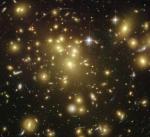 Abell 1689 Warps Space
9.01.2003
Two billion light-years away, galaxy cluster Abell 1689 is one of the most massive objects in the Universe. In this view from the Hubble Space Telescope's Advanced Camera for Surveys, Abell...
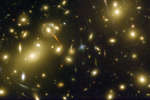 Abell 2218: A Galaxy Cluster Lens
10.02.2008
Gravity can bend light, allowing huge clusters of galaxies to act as telescopes. Almost all of the bright objects in this Hubble Space Telescope image are galaxies in the cluster known as Abell 2218.
 Earths Shrinking Antarctic Ice Sheet
8.03.2006
Is the continent at the end of the Earth slowly melting? For millions of years, Antarctica, the frozen continent at the southern end of planet Earth, has been encased in a gigantic sheet of ice. Recently, the orbiting robotic GRACE satellite has been taking sensitive measurements of the gravity for the entire Earth, including Antarctica.
|
January February March April May June July August September October |
|||||||||||||||||||||||||||||||||||||||||||||||||