
|
You entered: gravity
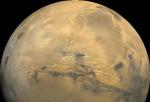 Mars: Just The Facts
27.06.1997
Mars, the freeze-dried planet, orbits 137 million miles from the Sun or at about 1.5 times the Earth-Sun distance. It has two diminutive moons, towering extinct volcanos, an immense canyon system, a thin atmosphere...
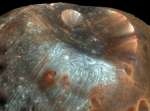 Stickney Crater
7.11.2009
Stickney Crater, the largest crater on the martian moon Phobos, is named for Chloe Angeline Stickney Hall, mathematician and wife of astronomer Asaph Hall. Asaph Hall discovered both the Red Planet's moons in 1877.
 JWST on the Road to L2
31.12.2021
This timelapse gif tracks the James Webb Space Telescope as it streaks across the stars of Orion on its journey to a destination beyond the Moon. Recorded on December 28, 12 consecutive exposures each 10 minutes long were aligned and combined with a subsequent color image of the background stars to create the animation.
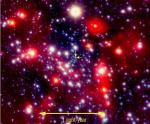 At the Center of the Milk Way
18.10.2002
At the center of our Milky Way Galaxy lies a black hole with over 2 million times the mass of the Sun. Once a controversial claim, this astounding conclusion is now virtually inescapable and based on observations of stars orbiting very near the galactic center.
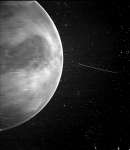 A Venus Flyby
25.02.2021
On a mission to explore the inner heliosphere and solar corona, on July 11, 2020 the Wide-field Imager on board NASA's Parker Solar Probe captured this stunning view of the nightside of Venus at distance of about 12,400 kilometers (7,693 miles).
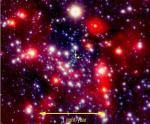 At the Center of the Milk Way
23.10.2005
At the center of our Milky Way Galaxy lies a black hole with over 2 million times the mass of the Sun. Once a controversial claim, this astounding conclusion is now virtually inescapable and based on observations of stars orbiting very near the galactic center.
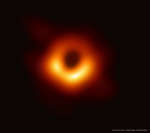 First Horizon Scale Image of a Black Hole
1.05.2022
What does a black hole look like? To find out, radio telescopes from around the Earth coordinated observations of black holes with the largest known event horizons on the sky. Alone, black holes are just black, but these monster attractors are known to be surrounded by glowing gas.
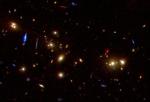 The Lynx Arc
5.11.2003
While chasing the spectrum of a mysterious arc in a cluster of galaxies within the obscure northerly constellation Lynx, astronomers have stumbled upon the most massive and distant star-forming region ever discovered. The notably...
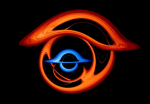 The Doubly Warped World of Binary Black Holes
16.04.2021
Light rays from accretion disks around a pair of orbiting supermassive black holes make their way through the warped space-time produced by extreme gravity in this stunning computer visualization. The simulated accretion disks have...
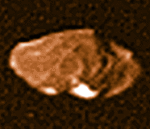 Jupiter's Moon Amalthea
3.11.1995
Amalthea is Jupiter's fifth largest moon, much smaller than the four Galilean satellites Io, Europa, Ganymede, and Callisto. The orbit of Amalthea is inside of these moons, and with its long axis always pointing toward Jupiter. It's dark surface color is probably due to sulfur being expelled from Io.
|
January February March April May June July August September October |
|||||||||||||||||||||||||||||||||||||||||||||||||