
|
You entered: radar
 Asteroid 1998 WT24 Passes Near Earth
24.12.2001
Last week, an asteroid approached unusually close to the Earth. Passing well outside the orbit of our Moon, Asteroid 1998 WT24 posed no danger, but became bright enough to see with binoculars and to track with radar. Pictured above, the kilometer-sized asteroid was imaged crossing the sky on December 14, two days before closest approach.
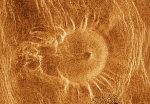 A Venusian Tick
23.08.1995
Data from the Magellan spacecraft has shown the Face of Venus to contain a host of volcanic features. This image shows an example of a fairly common type of venusian volcanic feature. Known...
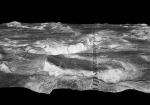 Atete Corona on Venus
12.03.2002
What could cause a huge cylindrical mountain to rise from the surface of Venus? Such features that occur on Venus are known as coronas. Pictured above in the foreground is 500-kilometer wide Atete Corona found in a region of Venus known as the Galindo.
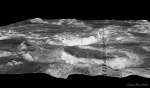 Cylindrical Mountains on Venus
16.10.2016
What could cause a huge cylindrical mountain to rise from the surface of Venus? Such features that occur on Venus are known as coronas. Pictured here in the foreground is 500-kilometer wide Atete Corona found in a region of Venus known as the Galindo.
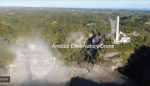 Arecibo Telescope Collapse
9.12.2020
This was one great scientific instrument. Starting in 1963, the 305-meters across Arecibo Telescope in Puerto Rico USA reigned as the largest single-dish radio telescope in the world for over 50 years. Among numerous...
 The Equal Night
23.09.2000
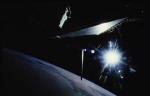
Yesterday the Sun crossed the celestial equator heading south, marking the Equinox -- the first day of Autumn in the northern hemisphere and Spring in the south. Equinox means equal night and with the Sun on the celestial equator, Earthlings will experience 12 hours of daylight and 12 hours of darkness.
 The Equal Night
22.09.1996
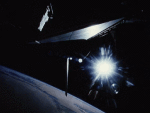
Today the Sun crosses the celestial equator heading south -- marking the Autumnal Equinox, the first day of Autumn. Equinox means equal night and with the Sun on the celestial equator, Earthlings will experience 12 hours of daylight and 12 hours of darkness.
 Venus: Earth's Sister Planet
15.08.1995
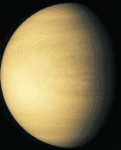
This picture in visible light was taken by the Galileo spacecraft. Venus is very similar to Earth in size and mass - and so is sometimes referred to as Earth's sister planet - but Venus has a quite different climate.
 The North Pole of Venus
14.05.2003
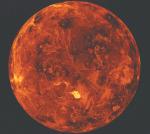
If you could look down on the North Pole of Venus what would you see? The Magellan probe that orbited Venus from 1990 to 1994 was able to peer through the thick Venusian clouds and build up the above image by emitting and re-detecting cloud-penetrating radar.
 Beneath Venus Clouds
28.11.1999
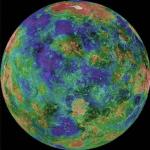
If the thick clouds covering Venus were removed, how would the surface appear? Using an imaging radar technique, the Magellan spacecraft was able to lift the veil from the Face of Venus and produce this spectacular high resolution image of the planet's surface. Red, in this false-color map, represents mountains, while blue represents valleys.
|
January February March April May June July August September |
|||||||||||||||||||||||||||||||||||||||||||||||||