
|
You entered: Saturn
 APOD: 2025 January 12 Б Mimas: Small Moon with a Big Crater
12.01.2025
Whatever hit Mimas nearly destroyed it. What remains is one of the largest impact craters on one of Saturn's smallest round moons. Analysis indicates that a slightly larger impact would have destroyed Mimas entirely.
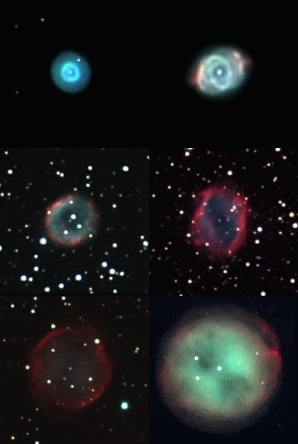 The Planetary Nebula Show
3.10.2001
What do the Owl, the Cat's Eye, the Ghost of Jupiter, and Saturn have in common? They're all planetary nebulae of course(!), glowing gaseous shrouds shed by dying sun-like stars as they run out of nuclear fuel.
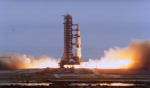 Apollo 11 Launches Humans to the Moon
16.07.2019
Everybody saw the Moon. Nobody had ever been there. Humans across planet Earth watched in awe 50 years ago today as a powerful Saturn V rocket attempted to launch humans -- to the Moon. Some...
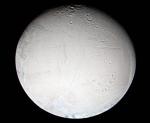 Ski Enceladus
24.02.2005
Small, icy, inner moon of Saturn, Enceladus is only about 500 kilometers in diameter. But the distant world does reflect over 90 percent of the sunlight it receives, giving its surface about the same reflectivity as fresh snow.
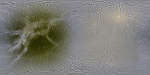 The Map of Dione
6.11.2014
This cylindrical projection global map is one of six new color maps of Saturn's midsized icy moons, constructed using 10 years of image data from the Cassini spacecraft. Discovered by Cassini (the astronomer) in 1684, Dione is about 1,120 kilometers across.
 Happy Birthday Jules Verne
15.02.2003
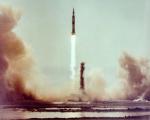
One hundred seventy-five years ago (on February 8th), Jules Verne was born in Nantes, France. Inspired by a lifelong fascination with machines, Verne wrote visionary works about "Extraordinary Voyages" including such terrestrial travels as Around the World in 80 Days, Journey to the Centre of the Earth, and Twenty Thousand Leagues Under the Sea.
 Three Kilometers Above Titan
18.05.2005
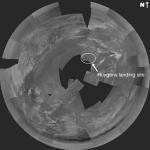
What did the Huygens probe see as it descended toward Saturn's Moon Titan? In January the robot Cassini spacecraft now orbiting Saturn released a probe through the dense cloud decks of one of the Solar System's most mysterious moons.
 The Planetary Nebula Show
14.06.2003
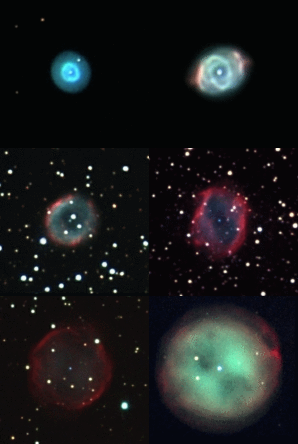
What do the Owl, the Cat's Eye, the Ghost of Jupiter, and Saturn have in common? They're all planetary nebulae of course, glowing gaseous shrouds shed by dying sun-like stars as they run out of nuclear fuel.
 Happy Birthday Jules Verne
17.02.2001
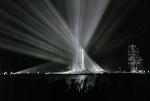
One hundred seventy-three years ago on February 8th, Jules Verne was born in Nantes, France. Inspired by a lifelong fascination with machines, Verne wrote visionary works about "Extraordinary Voyages" including such terrestrial travels as Around the World in 80 Days, Journey to the Centre of the Earth, and Twenty Thousand Leagues Under the Sea.
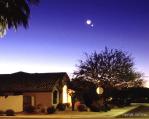 Venus, Moon, and Neighbors
6.04.2000
Rising before the Sun on February 2nd, astrophotographer Joe Orman anticipated this apparition of the bright morning star Venus near a lovely crescent Moon above a neighbor's house in suburban Phoenix, Arizona, USA.
|
January February March April May June July August September October |
|||||||||||||||||||||||||||||||||||||||||||||||||