
|
You entered: astronomer
 A Slice of the Universe with 2dF
14.06.2000
What can 100,000 galaxies tell you? Perhaps the structure and composition of the universe. Astronomers using the Two Degree Field (2dF) spectrograph on the Anglo-Australian Telescope (AAT) in Australia have now measured the redshifts of over 100,000 galaxies in a thin ribbon of the sky.
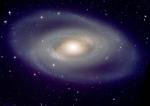 Spiral Galaxy NGC 1350
6.10.2005
This gorgeous island universe lies about 85 million light-years distant in the southern constellation Fornax. Inhabited by young blue star clusters, the spiral arms of NGC 1350 seem to join in a circle around the galaxy's large, bright nucleus - giving the galaxy the appearance of a limpid cosmic eye.
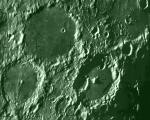 Hubble Resolves Expiration Date For Green Cheese Moon
1.04.2006
Using the new camera on the Hubble Space Telescope, astronomers have been able to confirm that the Moon is made of green cheese. The telling clue was the resolution of a marked date after which the Moon may go bad.
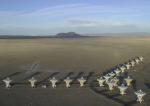 The Very Large Array of Radio Telescopes
14.05.2006
The most photogenic array of radio telescopes in the world has also been one of the most productive. Each of the 27 radio telescopes in the Very Large Array (VLA) is the size of a house and can be moved on train tracks.
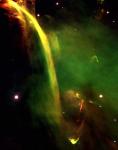 Arcs and Jets in Herbig Haro 34
29.11.1999
Some features of HH-34 are understood -- some are not. At the core of Herbig-Haro 34 lies a seemingly typical young star. This star, though, somehow ejects energetic "bullets" of high-energy particles, appearing as red streaks toward the lower right of the this image.
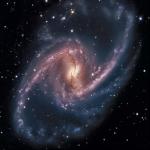 NGC 1365: Majestic Island Universe
28.03.2007
Barred spiral galaxy NGC 1365 is truly a majestic island universe some 200,000 light-years across. Located a mere 60 million light-years away toward the chemical constellation Fornax, NGC 1365 is a dominant member of the well-studied Fornax galaxy cluster.
 Fear and Dread: The Moons of Mars
30.10.2020
On Halloween fear and dread will stalk your night skies, also known as Phobos and Deimos the moons of Mars. The 2020 opposition of Mars was on October 13, so the Red Planet will still rise shortly after sunset.
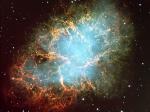 The Crab Nebula from VLT
14.07.2002
The Crab Nebula, filled with mysterious filaments, is the result of a star that was seen to explode in 1054 AD. This spectacular supernova explosion was recorded by Chinese and (quite probably) Anasazi Indian astronomers.
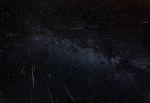 Raining Perseids
20.08.2004
Comet dust rained down on planet Earth last week, streaking through dark skies in the annual Perseid meteor shower. So, while enjoying the anticipated space weather, astronomer Fred Bruenjes recorded a series of many 30 second long exposures spanning about six hours on the night of August 11/12 using a wide angle lens.
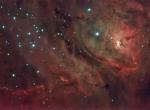 M8: The Lagoon Nebula
10.02.2006
This beautiful cosmic cloud is a popular stop on telescopic tours of the constellation Sagittarius. Eighteenth century cosmic tourist Charles Messier cataloged the bright nebula as M8, while modern day astronomers recognize the Lagoon...
|
January February March April May June July August |
||||||||||||||||||||||||||||||||||||||||||||||||||||||||